Ancient critter could be the granddaddy of shellfish
Jan 17, 2013
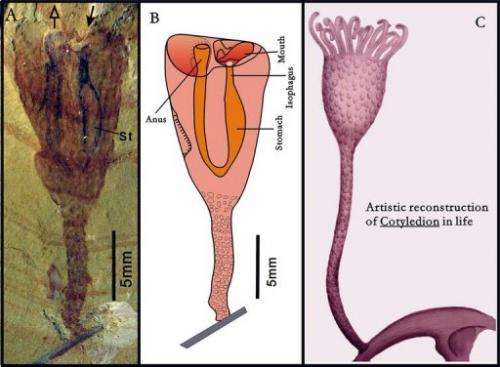
L-R: A Cotyledion tylodes fossil with U-shaped gut, an interpretative drawing, and an artistic reconstruction are pictured in a graphic released on January 17, 2013, by the scientific magazine "Nature". The marine creature, which lived 500 million years ago at a time of explosive growth in Earth's biodiversity, could be a forerunner of worms and molluscs, a study published on Thursday said.

A weird marine creature that lived 500 million years ago at a time of explosive growth in Earth's biodiversity could be a forerunner of worms and molluscs, a study published on Thursday said.

Palaeontologists in China and Europe have taken a second look at fossils of a species called Cotyledion tylodes—a small animal that, when it was identified in 1999, was at first thought to be a cnidarian, or part of a group of -like species.

C. tylodes had a goblet-shaped body between eight and 56 millimetres (0.3 to 2.2 inches) long, with a cup-shaped upper part and lower cylindrical stalk.

On the upper part, the creature's mouth lay adjacent to its anus, with the two organs connected by a U-shaped gut and encircled by a "crown" of foldable tentacles, the scientists found.

The peculiar anatomy means that C. tylodes is most probably an entoproct, meaning an organism that strains to filter out suspended .

If so, its place in the family tree is wrong, says the study. It is likely to be a primitive lophotrochozoan, a branch that today includes worms and shellfish.

The study appears in the Scientific Reports.

Explore further: Father of flying fish found in China, palaeontologists say

add to favorites email to friend print save as pdf

Related Stories

Bone-eating 'zombie' worms can no longer hide

Oct 31, 2011

Bone-eating 'zombie' worms may be good at keeping out of sight, living off dead whales in the darkness of the sea floor, but scientists have found out how to detect them, even if there’s no trace of their ...

Strange worm reveals the evolution of digestion

Oct 26, 2012

A Swedish–Norwegian research team shows in a new study that the intestines of the peculiar Penis worm develop in the same way as those in humans, fish and starfish. This surprising discovery shows that ...

Recommended for you

User comments : 0

More news stories

Social media puts HR ethics under the spotlight

Social media has definitely changed the game for job-seekers and recruiters. Traditionally, HR recruiters placed an advertisement, sifted through the responses, and interviewed the shortlisted candidates ...

Sony mulls hedge fund's entertainment sale idea

Sony's CEO Kazuo Hirai says the electronics giant's board will discuss a proposal by U.S. hedge fund manager Daniel Loeb to spin off up to 20 percent of its movie, TV and music division.

Italy approves law on controversial stem cell therapy

Italian lawmakers on Wednesday gave their final approval to a law that allows limited use of a controversial type of stem cell therapy which has been condemned by many scientists but has given hope to families of terminally-ill ...