The 3D fireworks of a star
Jan 24, 2013
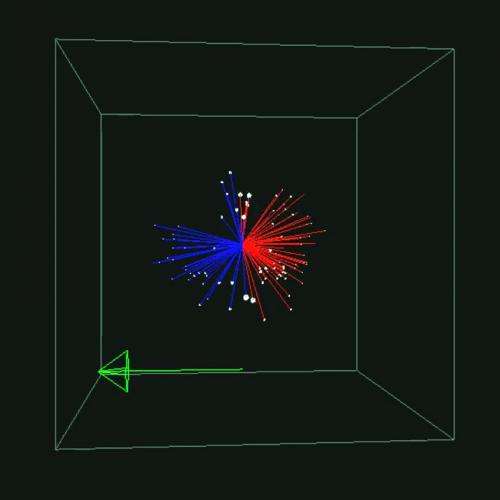
3D View of the Remnant of Nova Persei 1901 (the green arrow points to Earth). Credit: Liimets et al./ApJ.

In 1901 the star GK Persei gave off a powerful explosion that has not stopped growing and astonishing ever since. Now a team of Spanish and Estonian astronomers has reconstructed the journey of the emitted gas in 3D which, contrary to predictions, has hardly slowed down its speed of up to 1,000 km/s after all this time.

Thanks to the images captured from the Telescope and the Nordic Optical Telescope in La Palma (Canary Islands, Spain), a European team of astronomers has constructed a three dimensional map of the remnant of a nova, or in other words, what was left of the star after its explosion. The results have just been published in the .

The protagonist of this story is the star GK Persei situated at 'just' 1,300 light years away from Earth. It is also known as Nova Persei 1901 because a strong thermonuclear eruption occurred on its surface on the 21st February 1901. On that day astronomers observed how its brightness suddenly increased to such an extent that it became one of the brightest stars in the skies.

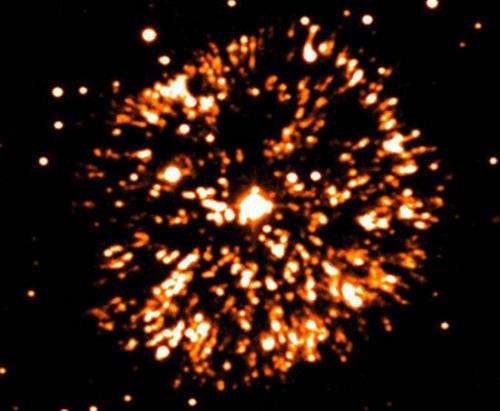
The surprising thing is that the explosion created remaining material made up of gaseous knots, which become visible in 1916. "From then the visual spectacle has been similar to that of a firework display seen in slow motion," claims Miguel Santander, researcher at Spanish National Observatory and coauthor of the study.
CCD image. Credit: Liimets at al./ApJ.

After patient work to gather images, the team was able to measure the movements of more than 200 knots as well as the radial velocity using the , which allows to determine if they are getting closer or moving further away from us. In this way the 3D map of the nova was created and its dynamic was analysed.

"Such data are rarely available in astrophysics because as a general rule apparent expansion or, in other words, in the layout of the sky, the majority of objects cannot be seen," outlines another of the authors, Romano Corradi, from the Astrophysics Institute of the Canary Islands.

This video is not supported by your browser at this time.
Apparent expansion of the Nova Persei 1901. Credit: Liimets at al./ApJ.

An unexpected result

In any case, the main result of this work "is that the gas seems to be moving further away in a ballistic or free manner and is hardly slowing down, contrary to what was thought in previous studies," comments the lead author of the investigation, Tiina Liimets of the Tartu Observatory in Estonia.

This video is not supported by your browser at this time.
3D View of the Remnant of Nova Persei 1901. Credit: Liimets at al./ApJ.

Until now it was thought that the gas from the explosion would slow down "significantly" due to the large quantity of matter in its path that the star has expelled previously. However, its speed has remained between a range of 600 and 1000 kilometres per second.

Long before the explosion in 1901, more than one hundred thousand years ago, GK Persei had already undergone a massive transformation from a red giant to a white dwarf. This process expelled its external layers forming a planetary nebula, which is a giant gas cloud within which the nova is now growing in 3D.

Explore further: New study suggests long ago brightest star explosion was rapid type Ia supernova

More information: Liimets, T. et al. A three-dimensional view of the remnant of Nova Persei 1901 (GK Per). Astrophysical Journal 761(1): id. 34, December 2012.

add to favorites email to friend print save as pdf

Related Stories

NASA’s STEREO spots a new nova

May 01, 2012

While on duty observing the Sun from its position in solar orbit, NASA’s STEREO-B spacecraft captured the sudden appearance of a distant bright object. This flare-up turned out to be a nova — designated ...

Fermi detects gamma-rays from exploding nova

Aug 23, 2010

Using the Large Area Telescope (LAT) onboard NASA's Fermi Gamma-ray Space Telescope satellite, astronomers have detected gamma rays from a nova for the first time, a finding that surprises both observers and ...

Remnant of an explosion with a powerful kick?

Feb 02, 2012

(PhysOrg.com) -- Vital clues about the devastating ends to the lives of massive stars can be found by studying the aftermath of their explosions. In its more than twelve years of science operations, NASA's ...

Star explosion leaves behind a rose

Dec 12, 2011

(PhysOrg.com) -- About 3,700 years ago, people on Earth would have seen a brand-new bright star in the sky. It slowly dimmed out of sight and was eventually forgotten, until modern astronomers later found ...

Recommended for you

Galaxy's Ring of Fire

May 18, 2013

Johnny Cash may have preferred this galaxy's burning ring of fire to the one he sang about falling into in his popular song. The "starburst ring" seen at center in red and yellow hues is not the product of ...

4C+29.30: Black hole powered jets plow into galaxy

May 15, 2013

(Phys.org) —This composite image of a galaxy illustrates how the intense gravity of a supermassive black hole can be tapped to generate immense power. The image contains X-ray data from NASA's Chandra X-ray ...

A space-time magnifying glass

May 15, 2013

(Phys.org) —Bright arcs are smeared around the heart of galaxy cluster Abell S1077 in this image taken by the NASA/ESA Hubble space telescope. The arcs are stretched images of distant galaxies distorted ...

User comments : 0

More news stories

Russia retrieves mice, newts from space

A Russian capsule filled with 45 mice and 15 newts along with other small animals returned from a month's mission in orbit on Sunday with data scientists hope will pave the way for a manned flight to Mars.

Galaxy's Ring of Fire

Johnny Cash may have preferred this galaxy's burning ring of fire to the one he sang about falling into in his popular song. The "starburst ring" seen at center in red and yellow hues is not the product of ...

Honeybees trained in Croatia to find land mines

(AP)—Mirjana Filipovic is still haunted by the land mine blast that killed her boyfriend and blew off her left leg while on a fishing trip nearly a decade ago. It happened in a field that was supposedly ...

German energy shift faces headwinds

Tense engineers have their eyes peeled on complex colour-coded diagrams on a wall-sized screen that makes their control room look like the inside of a spaceship.