Researchers create world's smallest reaction chamber
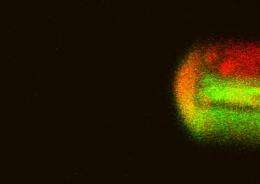
The world's smallest reaction chamber, with a mixing volume measured in femtolitres (million billionths of a litre), can be used to study the kind of speedy, nanoscale biochemical reactions that take place inside individual cells. By combining two electrospray emitters, not only can such reactions occur but the resulting products can be determined by mass spectrometry.
Scientists from New Zealand, Austria and the UK have created the world's smallest reaction chamber, with a mixing volume that can be measured in femtolitres.
Using this minuscule reaction chamber, lead researcher Peter Derrick, professor of chemical physics and physical chemistry and head of the Institute of Fundamental Sciences at Massey University in New Zealand, plans to study the kind of speedy, nanoscale biochemical reactions that take place inside individual cells. This work appears in the latest issue of the European Journal of Mass Spectrometry.
The reaction chamber actually consists of nothing more than a tiny spray of liquid. It is produced by a technique known as electrospray ionization, in which a liquid is converted into lots of charged droplets by exposing it to a high voltage as it exits the nozzle of a thin capillary.
Like water being sprayed out of a hose, these charged droplets form a cone shape, known as a Taylor cone, as they are emitted from the nozzle. Because the electrospray process transforms any chemical entities within the liquid into ions, it is a commonly used technique for ionizing a liquid sample prior to analysis by mass spectrometry.
In conventional electrospray ionization, the charged droplets are emitted from a single nozzle and form a single Taylor cone. Derrick realised that emitting charged droplets with different chemical compositions from two separate but adjoining nozzles would cause their respective Taylor cones to merge, potentially allowing the chemical entities in those droplets to react together.
By making the nozzles small enough, such that they produce Taylor cones with femtolitre volumes, and linking them to a mass spectrometer, this set-up could be used to study the kind of speedy, nanoscale biochemical reactions that take place within cells. "The idea was that the entities could be introduced separately through the two channels lying side-by-side into this extremely small volume," explains Derrick.
To test this approach, he and his colleagues fabricated a metal-coated dual-channel electrospray emitter, in which a single circular capillary, just 4.5 μm in diameter, is divided into two semi-circular channels. After first spraying different colour dye molecules from each channel and showing that the resultant Taylor cones merge together, the scientists sprayed the antibiotic vancyomycin from one channel and a version of the peptide it binds to from the other.
As expected, the two molecules bound to each other within the merged, femtolitre-size Taylor cone, with the whole reaction process taking just a few tens of microseconds. The resultant molecular complex formed by vancyomycin and the peptide could clearly be detected by the mass spectrometer.
"We showed that a device that works as hoped can be fabricated and that biochemical reactions do occur within the very small volume," says Derrick.
As well as offering a novel way to study biochemical reactions, this approach could provide a whole new way to conduct electrospray ionization. "This could become the standard method of doing electrospray," says Derrick, "because none of the myriad beneficial capabilities of present-day electrospray are lost through using just one channel for the sample. The other channel could then be used for compounds that can probe the chemical properties of the sample."
More information: The research is published as Lewis P. Mark, Matthew C. Gill, Marek Mahut and Peter J. Derrick, "Dual nano-electrospray for probing solution interactions and fast reactions of complex biomolecules", Eur. J. Mass Spectrom. 18(5), 439 (2012), doi: 10.1255/ejms.1198
Provided by Massey University


