Ocean science robot revolution hits symbolic millionth milestone
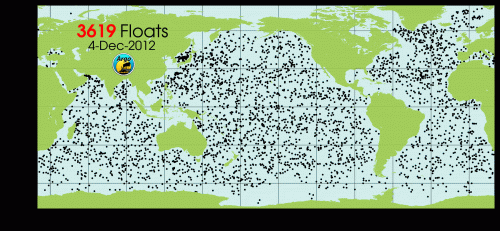
(Phys.org)—An innovative global observing system based on drifting sensors cycling from the surface to the ocean mid-depths is being celebrated by scientists today after reaching a major milestone – one million incredibly valuable ocean observations.
From 10 drifting robotic sensors deployed by Australia in the Indian Ocean in late 1999, the international research program has been quietly building up a global array which is now enabling new insights into the ocean's central influence on global climate and marine ecosystems.
The initial objective was to maintain a network of 3000 sensors, in ice-free open ocean areas, providing both real-time data and higher quality delayed mode data and analyses to underpin a new generation of ocean and climate services. The program is called Argo.
"We're still about 50 years behind the space community and its mission to reach the moon," says Argo co-Chair and CSIRO Wealth from Oceans Flagship scientist, Dr Susan Wijffels.
"The world's deep ocean environment is as hostile as that in space, but because it holds so many clues to our climate future exploring it with the Argo observing network is a real turning point for science.
"In its short life the Argo data set has become an essential mainstay of climate and ocean researchers complementing information from earth observing satellites and uniquely providing subsurface information giving new insights into changes in the earth's hydrological warming rates and opening the possibility of longer term climate forecasting," Dr Wijffels said.
Although the one millionth profile of the upper ocean, measured from the surface to a depth of two kilometres, was achieved in early November, oceanographers around the world are today celebrating this critical benchmark in ocean monitoring which delivers data to a scientist's desk within 24 hours of sampling.
Celebrations included a series of high-level international presentations by senior scientists involving Dr Wijffels, her Argo co-Chair Prof Dean Roemmich from Scripps Institution of Oceanography, oceanographer Dr Josh Willis from the NASA Jet Propulsion Laboratory, and Dr Jim Cummings from the US Naval Research Laboratory.
The Argo array has risen to now number more than 3500 sensors, the largest there has ever been. The average lifetime of the floats has improved in the past decade greatly increasing the efficiency of the operation.
Presently 28 countries contribute to the annual A$25M cost of operating the program. The US is the largest provider of sensors to the network, with Australia, led by CSIRO with the Integrated Marine Observing System and the Bureau of Meteorology, maintaining more than 300 profilers for deployment mainly in the Indian and Southern Oceans, and Tasman Sea.
The 1.5 metre tall robotic sensors cycle vertically every 10 days, sampling temperature and salinity. At the surface, the sensors despatches its data via satellite to national centres across the globe, where analysts then check it, package it and send it to synchronous assembly centres in France and the US. The sensor's ascent and descent is regulated by a hydraulic pump, powered with lithium batteries. Their life expectancy is between 4-9 years, averaging more than 200 profiles per sensor as they drift with the currents and eddies.
Data are collected at the impressive rate of one profile approximately every four minutes, (360 profiles per day or 11000 per month) and on 4 November 2012 Argo passed the symbolic milestone of collecting its one millionth profile. To put this achievement in context, since the start of deep sea oceanography in the late 19th century, ships have collected just over half a million temperature and salinity profiles to a depth of 1km and only 200000 to 2km. At the present rate of data collection Argo will take only eight years to collect its next million profiles.
Dr Wijffels said almost 1200 scientific papers based on or incorporating Argo data have been generated since the start of the program. Prominent findings include:
- Analysis of ocean salinity patterns that suggests a substantial (16 to 24%) intensification of the global water cycle will occur in a future 2° to 3° warmer world.
- A more detailed view of the world's largest ocean current, the Antarctic Circumpolar Current.
- An insight into changing bodies of water in the Southern Ocean and the way in which carbon dioxide is removed from the atmosphere.
- Isolating the effect of ocean warming and thermal expansion on the global energy and sea level budget.
Provided by CSIRO


