New 'virtual' tape measure could give online clothes shoppers the perfect fit
Nov 21, 2012
New 'virtual' tape measure could give online clothes shoppers the perfect fit
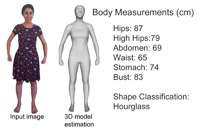
The new system builds up a detailed image of body measurements, making it much easier for the shopper to order the correct size for their body dimensions.

A ground-breaking web-based system that takes unprecedentedly detailed measurements of the body could revolutionise online clothes shopping.

The shopper would simply download software which, in conjunction with their webcam or smartphone, works like a 'virtual' tape measure, taking accurate waist, hip, chest and other measurements and advising the user on which size to buy whenever they visit the website of a participating retailer.

Taking multiple measurements of the body quickly, easily and accurately, the system aims to ensure the best possible fit and so save retailers and millions of pounds a year in return postage costs, as well as eliminating the hassle involved in sending back clothes that are the wrong size or fit.

With funding from the Engineering and Physical Sciences Research Council (EPSRC), the software is currently being developed by London College of Fashion and experts at the University of Surrey, in collaboration with body-mapping specialists Bodymetrics and digital creative agency Guided.

Body scanning is already starting to make a mark in the clothing retail sector. But because the new system takes measurements at a number of different points on the body and combines these with a person's overall proportions to build up a detailed , it offers much greater precision than anything else available in-store or online.

Moreover, most currently buy clothes simply on the basis of , for instance, or small/medium/large categorisation, whose accuracy is inevitably limited and often depends on the shopper's subjective perception of their own body size.

The new system avoids these problems. Once they find the item they are interested in, the shopper simply clicks their mouse to activate the software, stands in front of their webcam or in their underwear, takes a photo, types in their height and lets the software do the rest. The photo remains entirely confidential and is not transmitted over the internet in any way. The height measurement gives the software the starting point for ascertaining the body size of the shopper.

To inform customers, a logo (and possibly a pop-up on the computer screen) would appear on the websites of participating retailers. As slight variations often exist in the proportions of clothes with the same label size but produced by different manufacturers, retailers would also supply detailed information about the size of all their individual garments. The software would take this into account when recommending the size of a particular item for a particular shopper.

"The potential benefits for the fashion industry and for shoppers are huge," says Philip Delamore from London College of Fashion. "Currently, it's common for online shoppers to order two or three different sizes of the same item of clothing at the same time, as they're unsure which one will fit best."

Professor Adrian Hilton from the University of Surrey says: "It's unrealistic to expect online clothes shoppers to have the time or inclination to take a series of highly accurate body measurements of themselves. The new system makes it all very easy."

Plans to take the new system to market are now in hand, with a launch anticipated within two years.

Explore further: Virtual dressing rooms changing the shape of clothes shopping

add to favorites email to friend print save as pdf

Related Stories

Estonian robots boost global online clothing market

Apr 15, 2012

Fashion fans have one more reason to swap brick-and-mortar shops for online retailers: a company in tech-savvy Estonia has come up with a way to let you try on new clothes on your own computer.

Your right size without measuring for online shopping

Sep 25, 2012

A group of PHD students from the Computer Vision Centre (Universitat Autònoma de Bacelona) have developed an app called Verisize with which you can know your right size for any brand and garment when buying online. This ...

Augmented reality makes shopping more personal

Jul 03, 2012

While in-store shopping accounts for 92 percent of retail volume, consumers are expecting the same levels of personalization and customization that they do when they shop online; 58 percent of consumers want ...

Recommended for you

Model will unlock mysteries of the voice

May 22, 2013

Swedish researchers are leading the development of the world's first comprehensive model of the human voice, which could contribute to better voice care, voice prosthetics, talking robots and teaching opportunities.

Patented system better secures digitally stored data

May 21, 2013

(Phys.org) —Arizona State University computer scientist Gail-Joon Ahn has been granted a U.S. patent for a novel identity management system that helps protect personal identity information stored on digital devices.

UC Davis startup changes listening experience

May 20, 2013

Fifteen years of research at the University of California, Davis, is being turned into commercial products by Dysonics, a startup company based in San Francisco. Since becoming the first "graduate" from the Engineering Translational ...

Research finds new channels to trigger mobile malware

May 16, 2013

(Phys.org) —Researchers at the University of Alabama at Birmingham (UAB) have uncovered new hard-to-detect methods that criminals may use to trigger mobile device malware that could eventually lead to targeted ...

User comments : 2

Adjust slider to filter visible comments by rank

Display comments: newest first

tadchem
5 / 5 (1) Nov 21, 2012
This was anticipated 20 years ago, along with the option of applying the customer's measurements to a wide variety of basic designs and choice of materials to facilitate custom-tailored clothing orders without a tailor, online and to customer specifications.
From what I see now, the software needs some upgrading to accommodate variability in torso length, pelvic length, and such, as well as the various asymmetries that *real* humans show.
"More research is needed."
kevinrtrs
2.6 / 5 (5) Nov 21, 2012
stands in front of their webcam or smartphone in their underwear, takes a photo,

For hackers, this will probably become a popular piece of software to attack - imagine the possibilities of gaining information from right inside the person's house.
Just a thought.

More news stories

Solar plane sets distance record on US tour

The first manned aircraft that can fly day and night powered only by solar energy set a new distance record Thursday when it landed after the second leg of a cross-country US tour.

A hidden population of exotic neutron stars

(Phys.org) —Magnetars – the dense remains of dead stars that erupt sporadically with bursts of high-energy radiation - are some of the most extreme objects known in the Universe. A major campaign using ...

The secret lives, and deaths, of neurons

As the human body fine-tunes its neurological wiring, nerve cells often must fix a faulty connection by amputating an axon—the "business end" of the neuron that sends electrical impulses to tissues or other ...

Researchers suggest boosting body's natural flu killers

A known difficulty in fighting influenza (flu) is the ability of the flu viruses to mutate and thus evade various medications that were previously found to be effective. Researchers at the Hebrew University of Jerusalem have ...