Forecasting solar activity and the weather in space
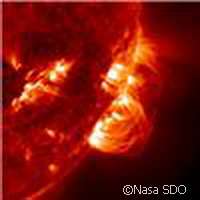
The ability to forecast periods of intense solar activity may be improved after scientists compared cycles of solar magnetic activity (over the past 10,000 years as reconstructed from ice cores) with the action of the planets. The Sun determines the course of the planets, but it has been discovered that the planets may also exert an influence on the Sun. Their configurations appear to be responsible for long-term cycles of increased solar activity.
This discovery is deemed important as our society becomes more dependent on technologies such as satellite communications and navigation systems - as well as power grids - which can be disabled by major solar eruptions. Scientists at Eawag and the ETH Zurich, in collaboration with colleagues from Australia and Spain, are continuing to study the configuration of the planets.
In their study, appearing in Astronomy & Astrophysics, the lead authors Professor José Abreu and Dr Jürg Beer from Eawag Aquatic Research demonstrate why they find the idea of planetary influence so convincing. Tracing the 5 most prominent periodicities of solar activity back over the last 10,000 years, they observed that the peaks and troughs reappear with precisely the same periodicity even after being reduced or vanishing altogether for some time. Dr Beer concludes, 'Everything points to an external 'clock', and that can really only be the planets.'
Direct evidence of the number of sunspots (a measure of solar activity) has only been available for around 400 years - the era of telescopic observations. This evidence was obtained from polar ice cores (from Antarctica and Greenland) in which radionuclides (an atom with an unstable nucleus) produced by cosmic rays are stored. During the Sun's quiescent periods, more cosmic rays enter the atmosphere - with increased production of radionuclides - as the blocking effect of the solar magnetic field is weaker.
The authors of the study are still describing their conclusions cautiously as hypothesis. However, if their findings are confirmed, they could be of major importance in helping to understand and develop more realistic models of the Sun. In addition, they could also help to generate more reliable forecasts of the space climate or even space weather for longer space voyages.
Their study also looked into the effect of superflares - huge eruptions of solar plasma, hurling billions of tonnes of gas into the atmosphere and causing magnetic storms in space and on Earth.
Satellites, aircraft avionics, power grids, radio signals and many other systems could be disrupted or destroyed by an event of this kind. But whether an improved understanding of solar magnetic activity will help to predict the frequency and intensity of such eruptions remains an open question. Dr Beer admits: 'Storm warnings are still a long way off. But the recent research takes us one step closer towards being able to give a better explanation of the longer-term space climate.'
More information: Abreu, J.A., Beer, J., Ferriz-Mas, A., McCracken, K.G. and Steinhilber, F., 'Is there a planetary influence on solar activity?', Astronomy & Astrophysics, 2012, 548. dx.doi.org/10.1051/0004-6361/201219997
Journal information: Astronomy & Astrophysics
Provided by CORDIS


