Rare rhino fossil preserved by prehistoric volcanic eruption
Nov 21, 2012
Credit: Pierre-Olivier Antoine

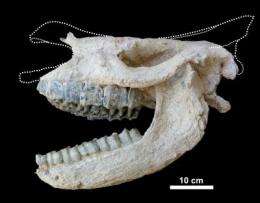
Less than 2% of the earth's fossils are preserved in volcanic rock, but researchers have identified a new one: the skull of a rhino that perished in a volcanic eruption 9.2 million years ago. The find is described in a paper published November 21 in the open access journal PLOS ONE by Pierre-Olivier Antoine and colleagues from the University of Montpellier, France.

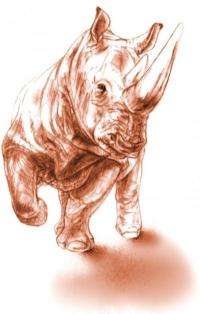
The fossil, found in Turkey, is thought to be that of a large two-horned rhino common in the Eastern Mediterranean region during that period. According to the researchers, unusual features of the preserved skull suggest that the animal was 'cooked to death' at temperatures that may have approached 500° C, in a volcanic flow similar to that of the eruption of Mt. Vesuvius in Italy in 79 A.D.

The rhino's grisly death was near-instantaneous, and followed by severe dehydration in the extreme heat of the eruption. As the researchers describe its end, "the body was baked under a temperature approximating 400°C, then dismembered within the pyroclastic flow, and the skull separated from body". The flow of then moved the skull about 30 km north of the eruption site, where it was discovered by the four member research team.
Credit: Reconstruction by Maëva J. Orliac

Although other researchers have previously identified fossils of soft-bodied organisms preserved in volcanic ash, organic matter near an active is usually quickly destroyed by the , making a fossil such as this one extremely rare.

Explore further: Indonesia warns of eruption on Anak Krakatau isle

More information: Antoine P-O, Orliac MJ, Atici G, Ulusoy I, Sen E, et al. (2012) A Rhinocerotid Skull Cooked-to-Death in a 9.2 Ma-Old Ignimbrite Flow of Turkey. PLoS ONE 7(11): e49997. doi:10.1371/journal.pone.0049997

Related Stories

Improving forecasts of volcanic ash concentrations

Feb 14, 2012

Volcanic ash can severely damage airplanes, and eruptions such as the 2010 Eyjafjallajokull eruption may result in major disruption to air travel. Improved forecasting of ash cloud locations and concentrations could benefit ...

Rare painted Roman-era statute is found

Mar 27, 2006

Scientists have found a Roman statue with its colors preserved, detailing for the first time a Roman woman wearing make-up, the London Times reported.

Volcanic blast influences climate

Aug 12, 2005

The volcanic ash cloud created by a volcanic blast can alter interactions between the atmosphere and sun, affecting climate patterns, say U.S. scientists.

Recommended for you

The ascent of man: Why our early ancestors took to two feet

11 hours ago

A new study by archaeologists at the University of York challenges evolutionary theories behind the development of our earliest ancestors from tree dwelling quadrupeds to upright bipeds capable of walking and scrambling.

Submerged structure stumps Israeli archaeologists

May 23, 2013

The massive circular structure appears to be an archaeologists dream: a recently discovered antiquity that could reveal secrets of ancient life in the Middle East and is just waiting to be excavated.

User comments : 0

More news stories

Challenging the public's view of gender and science

According to She Figures 2012, which analyses gender equality in research, in 2010 women accounted for only 10 % of university rectors in Europe and 15.5 % were heads of institutions of the higher education ...

Galaxies fed by funnels of fuel

(Phys.org) —Computer simulations of galaxies growing over billions of years have revealed a likely scenario for how they feed: a cosmic version of swirly straws.

Google eyes emerging markets networks

Google has become deeply involved in a series of projects to build and operate wireless networks in emerging markets including sub-Saharan Africa and Southeast Asia, a report said Friday.