Researchers find rainbows on nanoscale: Big impact on solar cells, television screens
Nov 20, 2012
King's College London finds rainbows on nanoscale
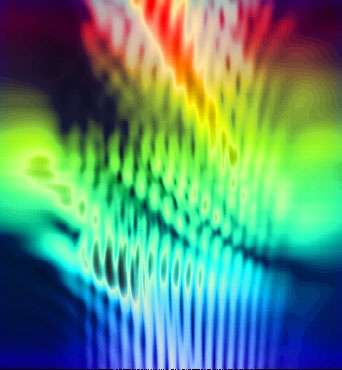
Researchers at King's College London discovered how to separate colours and create 'rainbows' using nanoscale structures on a metal surface. This may lead to improved solar cells, tv-screens and photo detectors. Credit: Dr. Jean-Sebastien Bouillard, Dr. Ryan McCarron

New research at King's College London may lead to improved solar cells and LED-displays. Researchers from the Biophysics and Nanotechnology Group at King's, led by Professor Anatoly Zayats in the department of Physics have demonstrated in detail how to separate colours and create 'rainbows' using nanoscale structures on a metal surface. The research is published in Nature's Scientific Reports.

More than 150 years ago, the discovery at King's of how to separate and project different colours, paved the way for modern colour televisions and displays. The major challenge for scientists in this discipline nowadays is the manipulation of colour at the nanoscale. This capability will have important implications for imaging and spectroscopy, sensing of chemical and and may lead to improved , flat-screen tv's and displays.

Researchers at King's were able to trap light of different colours at different positions of a nanostructured area, using especially designed nanostructures. Depending on the geometry of the , a trapped rainbow could be created on a gold film that has the dimension on the order of a few micrometers - about 100 times smaller than the width of a human hair.

Professor Zayats explained: 'Nanostructures of various kinds are being considered for solar cell applications to boost efficiency. Our results mean that we do not need to keep solar cells illuminated at a fixed angle without compromising the efficiency of light coupling in a wide range of wavelengths. When used in reverse for screens and displays, this will lead to wider viewing angles for all possible colours.'

The big difference to natural rainbows - where red always appears on the outer side and blue on the inner side - is that in the created nanostructures the researchers were able to control where the rainbow colours would appear by controlling the nanostructures' parameters. On top of this, they discovered that it is possible to separate colours on different sides of the nanostructures.

Co-author Dr Jean-Sebastien Bouillard from King's said: 'The effects demonstrated here will be important to provide 'colour' sensitivity in infrared imaging systems for security and product control. It will also enable the construction of microscale spectrometers for sensing applications.'

The ability to couple light to nanostructures with multicolour characteristics will be of major importance for light capturing devices in a huge range of applications, from light sources, displays, photo detectors and solar cells to sensing and light manipulation in optical circuits for tele- and data communications.

Explore further: Scientists shed light on glowing materials

More information: 'Broadband and broadangle SPP antennas based on plasmonic crystals with linear chirp' Nature's Scientific Reports, DOI: 10.1038/srep00829

Related Stories

Scientists shed light on glowing materials

Aug 20, 2012

Researchers at King's College London, in collaboration with European research institutes ICFO (Barcelona) and AMOLF (Amsterdam), have succeeded in mapping how light behaves in complex photonic materials inspired by nature, ...

Nanostructures worth more than their weight in gold

Oct 23, 2012

(Phys.org)—More effective monitoring of pollution levels in the workplace is on the horizon following the development of a new construction method for microscopic structures made of gold.

Nanostructures improve solar cell efficiency

May 26, 2011

To make solar cells a competitive alternative to other renewable energy sources, researchers are investigating different alternatives. A step in the right direction is through new processes that change the ...

Solar power could get boost from new light absorption design

Nov 02, 2011

Solar power may be on the rise, but solar cells are only as efficient as the amount of sunlight they collect. Under the direction of a new professor at Northwestern University's McCormick School of Engineering and Applied ...

Recommended for you

Engineers' nanoantennas improve infrared sensing

15 hours ago

(Phys.org) —A team of University of Pennsylvania engineers has used a pattern of nanoantennas to develop a new way of turning infrared light into mechanical action, opening the door to more sensitive infrared ...

Stacking 2-D materials produces surprising results

May 16, 2013

(Phys.org) —Graphene has dazzled scientists, ever since its discovery more than a decade ago, with its unequalled electronic properties, its strength and its light weight. But one long-sought goal has proved ...

User comments : 0

More news stories

Engineers' nanoantennas improve infrared sensing

(Phys.org) —A team of University of Pennsylvania engineers has used a pattern of nanoantennas to develop a new way of turning infrared light into mechanical action, opening the door to more sensitive infrared ...

Advance in nanotech gene sequencing technique

(Phys.org) —The allure of personalized medicine has made new, more efficient ways of sequencing genes a top research priority. One promising technique involves reading DNA bases using changes in electrical ...

Lab sets a new record for creating heralded photons

(Phys.org) —Entanglement, by general consensus of physicists, is the weirdest part of quantum science. To say that two particles, A and B, are entangled means that they are actually two parts of an inseparable ...

Protein study suggests drug side effects are inevitable

A new study of both computer-created and natural proteins suggests that the number of unique pockets – sites where small molecule pharmaceutical compounds can bind to proteins – is surprisingly small, meaning drug side ...

Do salamanders hold the solution to regeneration?

Salamanders' immune systems are key to their remarkable ability to regrow limbs, and could also underpin their ability to regenerate spinal cords, brain tissue and even parts of their hearts, scientists have ...