Physicists use Kinect to control holographic tweezers (w/ Video)
Nov 05, 2012 by Bob Yirka report
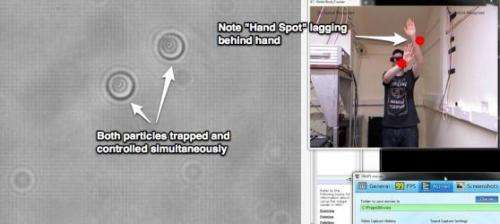
Kinect control of two trapped particles. Credit: C. McDonald

(Phys.org)—Researchers at the University of Dundee in Scotland have devised a means of using a Microsoft Kinect sensing system to allow for hand control of holographic optical tweezers. They describe their results in a paper they've uploaded to the preprint server arXiv.

are laser based devices that allow for manipulation of very small objects; typically at the cellular level. A laser beam is projected towards a , but before reaching it, is split into three separate beams. The three beams are broadcast onto the edges of the object to be manipulated – as the beams are moved the object is caused to move in lockstep. Thus far, however, fine tuning control of the laser to cause the movement of an object has been less than ideal, causing researchers to continue looking for alternative means. In this new research, the team connected a Microsoft Kinect device to the tweezers and then demonstrated an ability to move microscopic sized objects by moving their hands around in the air.

This video is not supported by your browser at this time.

The Kinect device employs a camera, an and a microchip to make sense of what the camera and laser detect in three . Its original purpose was to serve as a video game input device, but researchers have put it to use in many other applications. In this instance, by connecting a Kinect device to their virtual tweezers, the researchers found that they were able to define the space in which they wished to work by using simple hand movements and then to connect, virtually to a particular tiny object; in this case a silicon , and then to cause it to move, by making corresponding moves with their hand.

The Kinect device is not precise enough to capture subtle movements however, is error prone and doesn't allow for force-feedback, or the ability to feel the resistance of an object as its being moved, thus the resultant system, which the team calls HoloHands, is not sophisticated enough to allow for serious research work. Instead, they envision it being used as a tool for educational purposes, either as a tool, or implemented as a learning game.

Explore further: Company uses Kinect to create a touchscreen out of any surface (w/ Video)

More information: HoloHands: Kinect Control of Optical Tweezers, arXiv:1211.0220 [physics.pop-ph] arxiv.org/abs/1211.0220

Abstract
The increasing number of applications for holographic manipulation techniques has sparked the development of more accessible control interfaces. Here, we describe a holographic optical tweezers experiment that is controlled by gestures which are detected by a Microsoft Kinect. We demonstrate that this technique can be used to calibrate the tweezers using the Stokes Drag method and compare this to automated calibrations. We also show that multiple particle manipulation can be handled. This is a promising new line of research for gesture-based control that could find applications in a wide variety of experimental situations.

via TechReview

Related Stories

Tractor beams come to life

Sep 08, 2010

Tractor beams, energy rays that can move objects, are a science fiction mainstay. But now they are becoming a reality -- at least for moving very tiny objects.

Physics duo create tractor beam using dual Bessel beams

Oct 22, 2012

(Phys.org)—David Ruffner and David Grier of New York University have developed a technique for using Bessel beams to draw a particle toward a source. In their paper published in Physical Review Letters they d ...

Student Creates Electric Tweezers

Aug 18, 2006

The ability to sort cells or manipulate microscopic particles could soon be in the hands of small laboratories, high schools and amateur scientists, thanks to researchers at the University of Pennsylvania School ...

Microsoft Kinect makes moves on computers

Jun 17, 2011

Microsoft on Thursday began letting software developers imbue computers with voice and motion-sensing technology from its Kinect controller for the Xbox 360 videogame console.

Recommended for you

Breakthrough calls time on bootleg booze

18 hours ago

(Phys.org) —Using a laser, the St Andrews scientists can now carry out detailed analysis of a spirit sample no bigger than a teardrop and can even confirm whether it is toxic or not. It's hoped the testing ...

Bringing life into focus

May 17, 2013

Spinning-disk confocal microscopy is an optical imaging technique that can be used to generate detailed three-dimensional fluorescence images of living cells and their contents. Although a powerful tool for ...

World's smallest droplet

May 17, 2013

(Phys.org) —Physicists may have created the smallest drops of liquid ever made in the lab. That possibility has been raised by the results of a recent experiment conducted by Vanderbilt physicist Julia Velkovska and her ...

User comments : 1

Adjust slider to filter visible comments by rank

Display comments: newest first

liggerstuxin
1 / 5 (1) Nov 05, 2012
Pointless...

More news stories

Lab sets a new record for creating heralded photons

(Phys.org) —Entanglement, by general consensus of physicists, is the weirdest part of quantum science. To say that two particles, A and B, are entangled means that they are actually two parts of an inseparable ...

Competition in the quantum world

Innsbruck physicists led by Rainer Blatt and Peter Zoller experimentally gained a deep insight into the nature of quantum mechanical phase transitions. They are the first scientists that simulated the competition ...

Breakthrough calls time on bootleg booze

(Phys.org) —Using a laser, the St Andrews scientists can now carry out detailed analysis of a spirit sample no bigger than a teardrop and can even confirm whether it is toxic or not. It's hoped the testing ...

New principle may help explain why nature is quantum

Like small children, scientists are always asking the question 'why?'. One question they've yet to answer is why nature picked quantum physics, in all its weird glory, as a sensible way to behave. Researchers ...

New immune system discovered

(Medical Xpress)—A research team, led by Jeremy Barr, a biology post-doctoral fellow, unveils a new immune system that protects humans and animals from infection.

Protein study suggests drug side effects are inevitable

A new study of both computer-created and natural proteins suggests that the number of unique pockets – sites where small molecule pharmaceutical compounds can bind to proteins – is surprisingly small, meaning drug side ...