Research shows lemmings were wiped out by Ice Age's climate change
Nov 27, 2012
Research shows lemmings were wiped out by Ice Age's climate change

(Phys.org)—Small mammal populations across Europe were wiped out multiple times during the last Ice Age, due to an inability to deal with rapid climate change, according the research published today in the journal Proceedings of the Natural Academy of Sciences.

Led by researchers at Royal Holloway university, the international team of scientists found that a series of short-lived led to inhospitable environments for many cold-adapted animals, leading to a series of collapses in local ecosystems.

The research casts further doubt that humans played a significant role in causing the megafaunal extinction at the end of the last Ice Age – a period which saw the demise of many of the world's largest terrestrial animals, including woolly mammoth, giant deer and cave bears.

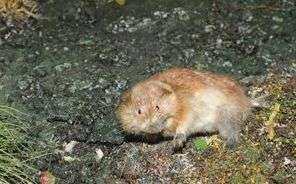
Focusing on a key arctic small called the collared lemming, the team analysed ancient from remains in caves in Belgium and the UK to obtain a picture of how it had evolved over the last 50,000 years. Previously, scientists had believed that this and other had been largely unaffected during the last Ice Age, and only disappeared from more southern regions at the beginning of the current warm stage around 10,000 years ago.

"By focusing on a small mammal, we could remove the possibility that humans were having any significant impact on their population size - lemmings are just too numerous and prolific. So any changes in the population had to be linked to wider environmental changes," said project leader, Dr Ian Barnes from the School of Biological Sciences at Royal Holloway.

"While lemmings have an undeserved reputation for leaping off cliffs, in reality they are critical for many ," said lead author Dr Selina Brace at Royal Holloway. "And removing them from the ecosystem would have massive knock-on effects for predators."

Scientists have known for a long time that the Ice Ages led to diversification and speciation in many animals. However, this study is one of the first to demonstrate that the climatic changes that took place during the last Ice Age, were also important drivers for the extinction process.

The results showed that a series of extinctions had taken place in Western Europe, and that each extinction was followed by recolonisation of genetically different lemmings.

"That the lemmings in Western Europe became extinct five times during the last Ice Age is unparalleled among mammals. We were really surprised by this finding," said Eleftheria Palkopoulou from the Swedish Museum of Natural History.

"Our research shows that the modern-day genetic variation in lemmings is just a small fraction of the variation that existed in the past. The amount of diversity that was lost due to these past changes in climate is simply stunning," said Dr Love Dalén from the Swedish Museum of Natural History.

Explore further: City-life changes blackbird personalities, study shows

Related Stories

Will lemmings fall off climate change cliff?

Apr 20, 2007

Contrary to popular belief, lemmings do not commit mass suicide by leaping off of cliffs into the sea. In fact, they are quite fond of staying alive. A bigger threat to the rodents is climate change, which ...

Small mammals have a 'Celtic fringe' too

Sep 30, 2009

The origin of the 'Celtic fringe' of genetically and culturally distinctive people in the northern and western British Isles is the source of fierce academic controversy.

Researchers discover important woolly rhino fossil

Sep 01, 2011

A paper to be published on September 2, 2011 in the authoritative magazine Science reveals the discovery of a primitive woolly rhino fossil in the Himalayas, which suggests some giant mammals first evolve ...

Recommended for you

City-life changes blackbird personalities, study shows

7 hours ago

The origins of a young animal might have a significant impact on its behavior later on in life. Researchers at the Max Planck Institute for Ornithology in Radolfzell, Germany, have been able to demonstrate ...

Origins of 'The Hoff' crab revealed (w/ Video)

7 hours ago

The history of a new type of crab, nicknamed 'The Hoff' because of its hairy chest, which lives around hydrothermal vents deep beneath the Southern Ocean and Indian Ocean, has been revealed for the first ...

Personality test finds some mouse lemurs shy, others bold

13 hours ago

Anyone who has ever owned a pet will tell you that it has a unique personality. Yet only in the last 10 years has the study of animal personality started to gain ground with behavioral ecologists, said Jennifer ...

Lonely bees make better guests

20 hours ago

Solitary bees are twice as likely to pollinate the flowers they visit as their more sociable counterparts, according to a new study.

User comments : 5

Adjust slider to filter visible comments by rank

Display comments: newest first

jscroft
1.8 / 5 (5) Nov 27, 2012
This time they all voted for Obama.
tadchem
4 / 5 (4) Nov 27, 2012
If the Ice Age led to extinction of specific lemming populations, one may expect that a warming climate would conversely support genetic diversification.
Claudius
2 / 5 (5) Nov 27, 2012
The lemmings probably went extinct when they all decided to direct their movements by consensus over the nearest cliff.
jscroft
2 / 5 (5) Nov 27, 2012
Consensus? I had no idea lemmings were scientific creatures!
C_elegans
5 / 5 (1) Nov 27, 2012
Tadchem - they were eliminated by rapid climate change.

Counterpoint - Rainforests are warm and contain most of the world's diversity. They also have been the most stable climates found on Earth.

More news stories

Origins of 'The Hoff' crab revealed (w/ Video)

The history of a new type of crab, nicknamed 'The Hoff' because of its hairy chest, which lives around hydrothermal vents deep beneath the Southern Ocean and Indian Ocean, has been revealed for the first ...

3D printing tiny batteries

(Phys.org) —3D printing can now be used to print lithium-ion microbatteries the size of a grain of sand. The printed microbatteries could supply electricity to tiny devices in fields from medicine to communications, ...