International Space Station salutes the Sun

Nov 29, 2012
The International Space Station taken from Space Shuttle Discovery as the Sun rises from behind Earth. The STS-119 and Expedition 18 crew took this picture after leaving the Space Station in March 2009. Credit: NASA/ESA

(Phys.org)—This weekend the International Space Station will turn itself to position ESA's SOLAR instrument for a better view of the Sun. It will be the first time the Station has changed attitude for scientific reasons alone.

SOLAR has been monitoring our Sun's output since it was installed on ESA's module in February 2008. The package will celebrate its next year.

"That is quite an achievement," says Nadia This, operations engineer at the Belgian User Support and Operations Centre that controls SOLAR. "The instrument was designed to work for only 18 months."

SOLAR needs to be in direct view of the Sun to take but the Space Station's normal orbit obscures the view for two weeks every month.
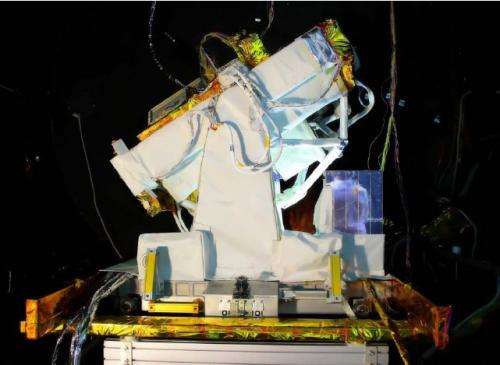
SOLAR consists of three complementary instruments: SOVIM (SOlar Variable and Irradiance Monitor) covers the near-ultraviolet, visible and thermal-infrared regions of the spectrum; SOL-ACES (SOLar Auto-Calibrating Extreme UV/UV Spectrophotometers) measures the extreme ultraviolet; and SOLSPEC (SOLar SPECtral Irradiance measurements) covers the 180–3000 nm wavelength range. Credit: ESA

"We want to record a complete rotation of the Sun and that takes around 25 days," explains Nadia.

The solution is to rotate the whole Station but moving a 450 tonne orbital outpost the size of a typical block of flats is not a simple undertaking.

Aside from calculating the correct orbit to keep SOLAR in view of the Sun, other factors need to be taken into account such as ensuring the that power the Station are not left in the dark.

Communication antennas need to be reoriented to stay in contact with Earth and other must be adjusted.

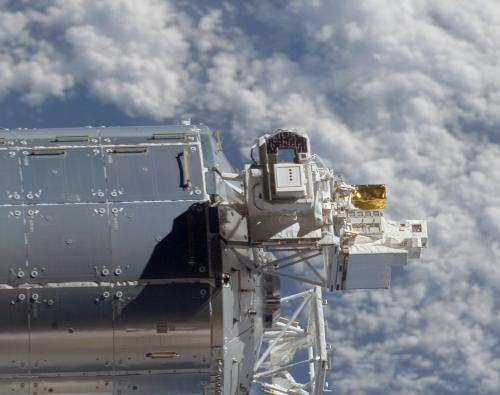
SOLAR installed on ESA’s Columbus laboratory on the International Space Station. SOLAR consists of three complementary instruments: SOVIM (SOlar Variable and Irradiance Monitor) covers the near-ultraviolet, visible and thermal-infrared regions of the spectrum; SOL-ACES (SOLar Auto-Calibrating Extreme UV/UV Spectrophotometers) measures the extreme ultraviolet; and SOLSPEC (SOLar SPECtral Irradiance measurements) covers the 180–3000 nm wavelength range. Credit: ESA/NASA

High-level discussions with all five Space Station partners were needed before the go-ahead was given.

SOLAR started recording a full rotation of the Sun on 19 November. On 1 December the Station will spend two hours turning about 7º so that observations can continue. It will hold this angle for ten days before returning to its original . As usual, the Belgian centre will be following its progress 24 hours a day.

SOLAR's observations are improving our understanding of the Sun and allowing scientists to create accurate computer models and predict its behaviour. The more accurate data we acquire, the more we will understand our nearest star's influence on Earth.

Recently, the 11-year solar cycle has shown irregularities and the next maximum is expected in 2013, so SOLAR's spectral readings are of particular interest to scientists.

Explore further: Solar minimum; solar maximum

add to favorites email to friend print save as pdf

Related Stories

The Sun Loses its Spots

Jul 24, 2007

While sidewalks crackle in the summer heat, NASA scientists are keeping a close eye on the sun. It is almost spotless, a sign that the Sun may have reached solar minimum. Scientists are now watching for the ...

ESA's SOHO will lead a fleet of solar observatories

May 24, 2006

New funding, to extend the mission of ESA's venerable solar watchdog SOHO, will ensure it plays a leading part in the fleet of solar spacecraft scheduled to be launched over the next few years.

ESA To Collaborate with NASA on Solar Science Mission

Oct 06, 2011

On October 4, 2011, the European Space Agency announced it's two next science missions, including Solar Orbiter, a spacecraft geared to study the powerful influence of the sun. Solar Orbiter will be an ESA-led ...

Solar Dynamics Observatory goes for a spin

Apr 09, 2012

(Phys.org) -- On April 4, 2012, NASA's Solar Dynamics Observatory (SDO) did a 360. It rolled completely around its axis – something it does twice a year. In this movie, the dizzying view looks as if the ...

Solar minimum; solar maximum

Nov 27, 2012

(Phys.org)—The picture on the left shows a calm sun from Oct. 2010. The right side, from Oct. 2012, shows a much more active and varied solar atmosphere as the sun moves closer to peak solar activity, a ...

Recommended for you

Super-hurricane-force winds on Venus are getting stronger

15 hours ago

(Phys.org) —As the closest planet to Earth, Venus is a relatively easy object to observe. However, many mysteries remain, not least the super-rotation of Venus' atmosphere, which enables high altitude winds ...

ExoMars 2016 set to complete construction

20 hours ago

ESA's mission to Mars in 2016 has entered the final stage of construction with the signature of a contract today with Thales Alenia Space at the Paris Air & Space Show.

Australian team maps Moon's hidden craters

23 hours ago

Australian scientists Tuesday said they had identified a possible 280 additional craters on the Moon, a finding they said could shed light on the history of the Earth's natural satellite.

User comments : 0

More news stories

3D printing tiny batteries

(Phys.org) —3D printing can now be used to print lithium-ion microbatteries the size of a grain of sand. The printed microbatteries could supply electricity to tiny devices in fields from medicine to communications, ...