November 15, 2012 report
Researchers entangle a single electron spin to a single photon in a quantum dot
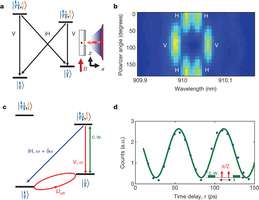
(Phys.org)—Two teams working independently have succeeded in entangling a single electron spin with a single photon in a solid-state platform. Both teams describe their process and results in papers they've had published in the journal Nature. The two teams used laser pulses fired at quantum dots to entangle pairs of electrons and photons then used different techniques to remove either the shared color that resulted or their polarization.
To create a quantum computer, scientists believe it will be necessary to combine or connect stationary quantum bits (qubits) with mobile or "flying" qubits. Thus, research has been focused on building a system in which this is possible. In this new research, quantum dots were used to represent the stationary particles while photons were used to represent those that fly. To connect them, the researchers relied on entanglement between pairs of particles and the properties they share.
In their labs, both teams used very small semiconductors to trap a single electron, e.g. a quantum dot. They then both fired a laser at the dot to set its spin state to either up or down (representing "0" or "1"). Next both teams also fired another laser pulse at the dot to force it to a higher energy level. Doing so caused an entangled photon to be released as the energy decayed. The photon was emitted as either horizontally or vertically polarized with a wavelength that was demonstrated by either a red or blue color. It was at this stage that the work between the two teams diverged. To use the information from a (qubit) in a quantum system, only one of the two properties can be allowed to exist; thus the other must be removed. The first team's work involved removing the color, the second, the polarization.
To remove the color the first team ran the photon through a crystal that was also shot with a laser beam. Doing so caused the colors to smear which was enough to remove that property from the entangled particles. The second team removed the polarization by allowing the photon to pass through a polarizing filter which forced it into an anticlockwise state which effectively erased the shared property from the particles.
More information: 1. Quantum-dot spin–photon entanglement via frequency downconversion to telecom wavelength, Nature, 491, 421–425 (15 November 2012) doi:10.1038/nature11577
Abstract
Long-distance quantum teleportation and quantum repeater technologies require entanglement between a single matter quantum bit (qubit) and a telecommunications (telecom)-wavelength photonic qubit. Electron spins in III–V semiconductor quantum dots are among the matter qubits that allow for the fastest spin manipulation and photon emission, but entanglement between a single quantum-dot spin qubit and a flying (propagating) photonic qubit has yet to be demonstrated. Moreover, many quantum dots emit single photons at visible to near-infrared wavelengths, where silica fibre losses are so high that long-distance quantum communication protocols become difficult to implement. Here we demonstrate entanglement between an InAs quantum-dot electron spin qubit and a photonic qubit, by frequency downconversion of a spontaneously emitted photon from a singly charged quantum dot to a wavelength of 1,560 nanometres. The use of sub-10-picosecond pulses at a wavelength of 2.2 micrometres in the frequency downconversion process provides the necessary quantum erasure to eliminate which-path information in the photon energy. Together with previously demonstrated indistinguishable single-photon emission at high repetition rates, the present technique advances the III–V semiconductor quantum-dot spin system as a promising platform for long-distance quantum communication.
2. Observation of entanglement between a quantum dot spin and a single photon, Nature, 491, 426–430 (15 November 2012) doi:10.1038/nature11573
Abstract
Entanglement has a central role in fundamental tests of quantum mechanics1 as well as in the burgeoning field of quantum information processing. Particularly in the context of quantum networks and communication, a main challenge is the efficient generation of entanglement between stationary (spin) and propagating (photon) quantum bits. Here we report the observation of quantum entanglement between a semiconductor quantum dot spin and the colour of a propagating optical photon. The demonstration of entanglement relies on the use of fast, single-photon detection, which allows us to project the photon into a superposition of red and blue frequency components. Our results extend the previous demonstrations of single-spin/single-photon entanglement in trapped ions, neutral atoms and nitrogen–vacancy centres to the domain of artificial atoms in semiconductor nanostructures that allow for on-chip integration of electronic and photonic elements. As a result of its fast optical transitions and favourable selection rules, the scheme we implement could in principle generate nearly deterministic entangled spin–photon pairs at a rate determined ultimately by the high spontaneous emission rate. Our observation constitutes a first step towards implementation of a quantum network with nodes consisting of semiconductor spin quantum bits.
Journal information: Nature
© 2012 Phys.org


