Cygnus OB2: Probing a nearby stellar cradle
Nov 08, 2012
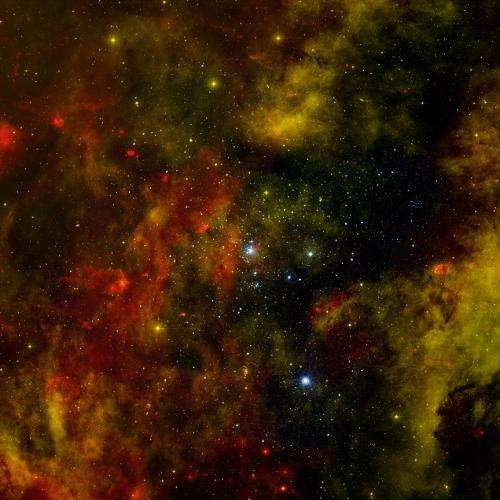
Composite view of Cygnus OB2.

(Phys.org)—The Milky Way and other galaxies in the universe harbor many young star clusters and associations that each contain hundreds to thousands of hot, massive, young stars known as O and B stars. The star cluster Cygnus OB2 contains more than 60 O-type stars and about a thousand B-type stars. At a relatively nearby distance to Earth of about 5,000 light years, Cygnus OB2 is the closest massive cluster.

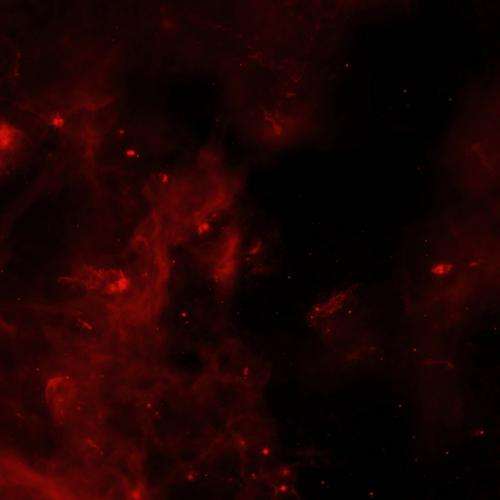
Deep observations with NASA's Chandra X-ray Observatory of Cygnus OB2 have been used to detect the X-ray emission from the hot outer atmospheres, or coronas, of young stars in the cluster and to probe how these great star factories form and evolve. About 1,700 X-ray sources were detected, including about 1,450 thought to be stars in the cluster. In this image, X-rays from Chandra (blue) have been combined with infrared data from NASA's (red) and optical data from the Telescope (orange).

Infrared view of Cygnus OB2. Credit: NASA/JPL-Caltech

Young stars ranging in age from one million to seven million years were detected. The infrared data indicates that a very low fraction of the stars have circumstellar disks of dust and gas. Even fewer disks were found close to the massive OB stars, betraying the corrosive power of their that leads to early destruction of their disks. Evidence is also seen that the older population of stars has lost its most massive members because of supernova explosions. Finally, a total mass of about 30,000 times the mass of the sun is derived for Cygnus OB2, similar to that of the most massive star forming regions in our Galaxy.
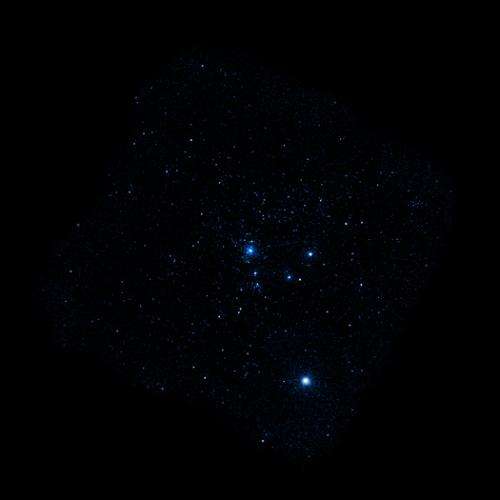
X-ray view of Cygnus OB2. Credit: NASA/CXC/SAO/J.Drake et al

NASA's Marshall Space Flight Center in Huntsville, Ala., manages the Chandra program for NASA's Science Mission Directorate in Washington. The Smithsonian Astrophysical Observatory controls Chandra's science and flight operations from Cambridge, Mass.
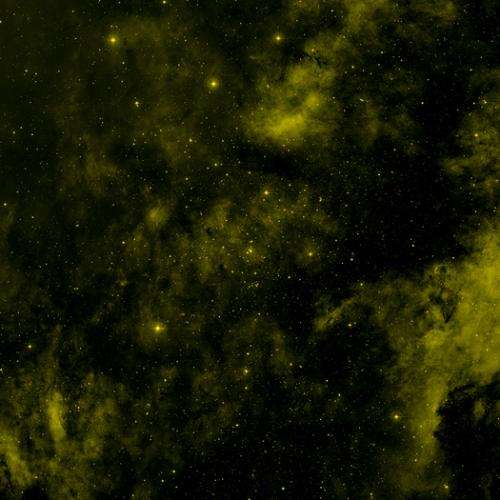
Optical view of Cygnus OB2. Credit: Univ. of Hertfordshire/INT/IPHAS


Explore further: Unusual supernova is doubly unusual for being perfectly normal

Related Stories

Chandra Lifts the Veil on Milky Way 'Hotspot'

Jan 23, 2008

NASA's Chandra X-ray Observatory is helping to demystify Westerlund 2, a young star cluster with an estimated age of about one- or two-million years. Heavily obscured by dust and gas, Westerlund 2 has been ...

Space image: Carina Nebula: 14,000+ Stars

Oct 17, 2011

(PhysOrg.com) -- The Carina Nebula is a star-forming region in the Sagittarius-Carina arm of the Milky Way that is 7,500 light years from Earth and the Chandra X-Ray Observatory has detected more than 14,000 ...

'Proplyd-like' objects discovered in Cygnus OB2

Jan 16, 2012

The well known Orion Nebula is perhaps the most well known star forming regions in the sky. The four massive stars known as the trapezium illuminate the massive cloud of gas and dust busily forming into new ...

Hunting for the Milky Way's heaviest stars

Apr 14, 2011

(PhysOrg.com) -- NASA observatories have located strong infrared signals near the plane of the Milky Way, suggesting the possible presence of massive stars.

Image: A Galactic Spectacle

Aug 05, 2010

A beautiful new image of two colliding galaxies has been released by NASA's Great Observatories. The Antennae galaxies, located about 62 million light-years from Earth, are shown in this composite image from ...

Recommended for you

Three centaurs follow Uranus through the solar system

Jun 18, 2013

Astrophysicists from the Complutense University of Madrid have confirmed that Crantor, a large asteroid with a diameter of 70 km has an orbit similar to that of Uranus and takes the same amount of time to ...

Final curtain for Europe's deep-space telescope

Jun 17, 2013

The deep-space telescope Herschel took its final bow on Monday, climaxing a successful four-year mission to observe the birth of stars and galaxies, the European Space Agency (ESA) said.

Hubble spots a very bright contortionist

Jun 17, 2013

(Phys.org) —The contorted object captured by Hubble in this picture is IRAS 22491-1808, also known as the South America Galaxy. It is an ultra-luminous infrared galaxy (ULIRG) that emits a huge amount of ...

Study explains decades of black hole observations

Jun 14, 2013

(Phys.org) —A new study by astronomers at NASA, Johns Hopkins University and Rochester Institute of Technology confirms long-held suspicions about how stellar-mass black holes produce their highest-energy ...

User comments : 0

More news stories

Metamorphosis of moon's water ice explained

Using data gathered by NASA's Lunar Reconnaissance Orbiter (LRO) mission, scientists believe they have solved a mystery from one of the solar system's coldest regions—a permanently shadowed crater on the ...

Looking at sachet water consumption in Ghana

Many of West Africa's largest cities continue to lag in their provision of piped water to residents. Filling the service gap are plastic water sachets, which have become an important source of drinking water ...

The broken symphony of swinging metronomes

An experiment with 30 metronomes reveals chimera states which combine aspects of synchrony and of disorder. Researchers had been looking for such states for ten years.