Worldwide patent for a Spanish stroke rehabilitation robot
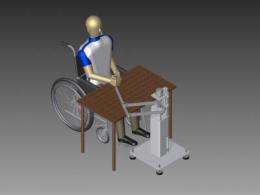
Robotherapist 3D, a robot which aids stroke patients' recovery, is to be brought to market by its worldwide patent holder, a spin-off company from the Miguel Hernández University of Elche (Alicante, Spain). It is the first robot to enable patients to start doing exercises while supine, allowing them to begin shortly after the stroke and expediting recovery.
The Biomedical Neuroengineering Group at the Miguel Hernández University of Elche in Alicante has recently established a spin-off technologies company, Instead Technologies. It was founded in order to market the robots they have developed to aid stroke patients' recovery, Nicolás García-Aracil, a founding member of the company, informs SINC.
The company, a leader in this field in Spain, already has two robots: Robotherapist 2D and Robotherapist 3D. For the latter, it has a worldwide patent. Both are actuated by pneumatic technology and have been designed to improve arm movement in stroke patients.
According to the researcher, Robotherapist 2D is a planar robot which allows movement in two dimensions and includes sensors to determine the patient's condition and a sound feedback system. "With this robot, certain tasks are carried out. The patient's arm is moved parallel to the table: to the right, to the left and in a straight line. They are exercises to improve coordination," he says.
Neuroplasticity
After a stroke, in addition to suffering from hemiplegia, patients will suffer from spasticity or muscle tightness. If patients cannot move their arm, the robot helps them lift it to a specific point. "These exercises improve neuroplasticity and re-establish damaged connections", the researcher explains.
Instead Technologies does not hold the patent on this system. "It is a pre-existing technology. What we are thinking of patenting though is the type of rehabilitation and care procedure which we are developing," adds García-Aracil.
Robotherapist 2D is already being trialled with a chronic stroke patient, "and the results are promising." They will now conduct a trial with patients from the rehabilitation unit of a public university hospital, before the robot is approved. "Some patients will receive conventional physiotherapy, while others will be treated with the help of the robot. The results will then be compared."
Daily tasks
The second robot developed by the Biomedical Neuroengineering Group is Robotherapist 3D, whose worldwide patent has been granted to Instead Technologies. This new machine helps patients to perform movements in all positions and directions. In addition, it has a virtual reality system so that people can start to carry out everyday tasks again, such as lifting a glass of water to their mouth.
The robot "allows you to follow all of the steps involved in rehabilitation, firstly with passive movements of the upper limbs. When you have reached a certain level of mobility, you continue with occupational therapy, performing everyday tasks such as eating and drinking, all by means of virtual reality," the researcher emphasises.
The company is financing the making of two prototypes and it has asked the Centre for Industrial Technological Development (CDTI), as well as a private hospital, for help in starting the trials in public and private hospitals.
The only one of its kind in Spain
Prior to the establishment of Instead Technologies, there were no companies in Spain which specialised in rehabilitation robots. And they are few and far between in the world in general. The main such companies are the Swiss company Hocoma and the US company Interactive Motion Technologies.
This gap in the market inspired some members of the Biomedical Neuroengineering Group at the Miguel Hernández University of Elche to create a spin-off company, with the aim of bringing their own robots to market: Robotherapist 2D and Robotherapist 3D. Their target users are public and private hospitals and rehabilitation clinics in Europe and emerging Latin American countries, according to Nicolas García-Aracil, group researcher and founding member of its company.
The company consists of five team members who are experts in the fields of medicine, IT, engineering, biology and biochemistry. There is also a sixth external member; a professional from the health industry whose identity remains confidential.
At present, the company is focussing on robots which facilitate stroke recovery, however it is also collaborating with associations linked with other diseases: Parkinson's, Alzheimer's and multiple sclerosis. "In general, these robots can be used to help rehabilitate people who have suffered brain damage or those who are in the early stages of a neurodegenerative disease," García-Aracil explains.
According to this researcher, although Robotherapist 3D is the most recent robot, both are valuable in different types of rehabilitation.
More information: Badesa, Francisco; Morales, Ricardo; Garcia-Aracil, Nicolas; Sabater, Jose M.; Perez-Vidal, Carlos; Fernandez, Eduardo. "Multimodal interfaces to improve therapeutic outcomes in robot-assisted rehabilitation". IEEE Transactions on Systems, Man, and Cybernetics—Part C.
Ricardo Morales, Francisco Javier Badesa, Nicolás García-Aracil, José María Sabater, Carlos Pérez-Vidal. "Pneumatic robotic systems for upper limb rehabilitation". Journal: Medical and Biological Engineering and Computing,1-12. Springer Berlin/Heidelberg.


