Tropical Storm Maliksi forms, Iwo To on guard
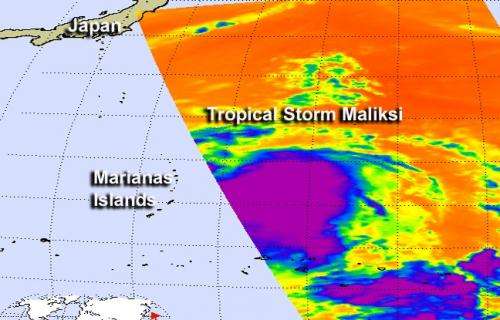
The western North Pacific is in full swing, tropically speaking and NASA observed the birth of Tropical Storm Maliksi on Sept. 30. NASA's Aqua satellite captured an infrared image of the storm when it was a depression and revealed a large area of powerful thunderstorms around its center that hinted at its strengthening.
Tropical Storm Maliksi formed from the twentieth tropical depression of the western North Pacific typhoon season. Tropical Depression 20W formed on Sept. 20 about 305 nautical miles from Guam near 16.3 North and 149.0 East. It is moving to the north-northwest at 11 knots (12.6 mph/20.3 kph).
On Oct. 1 the depression strengthened into a tropical storm. At 1500 UTC (11 a.m. EDT) it was located near 19.3 North and 145.1 East about 50 nautical miles (57.5 miles/92.6 km) northwest of Pagan, in the Northern Marianas archipelago. It is under the jurisdiction of the Commonwealth of the Northern Mariana Islands. It had maximum sustained winds near 35 knots (40 mph/65 kph). The Marianas Islands are an arc-shaped archipelago. The island chain includes fifteen volcanic mountains.
When NASA's Aqua satellite passed over Tropical Depression 20W in the western North Pacific, it captured an infrared image with the Atmospheric Infrared Sounder (AIRS) instrument on Oct. 1 at 02:53 UTC (10:53 p.m. EDT, Sept. 30). A large area of powerful thunderstorms with very cold cloud top temperatures (colder than -63F/-52 C) surrounded the center of circulation, hinting that the storm was organizing and strengthening. It became a tropical storm hours after the image was taken.
Maliksi has organized during the morning hours of Oct. 1, with strongest convection (rising air that forms thunderstorms) and bands of thunderstorms over the southeastern quadrant. Those bands of thunderstorms, however, have not yet begun wrapping into the low level center, which is an indication that the storm still has a way to go to get fully organized.
Maliksi is expected to pass Iwo To during October 3 and strengthen into a typhoon on its journey to the northeast.
Provided by NASA's Goddard Space Flight Center


