Sun spits out a coronal mass ejection
Oct 05, 2012
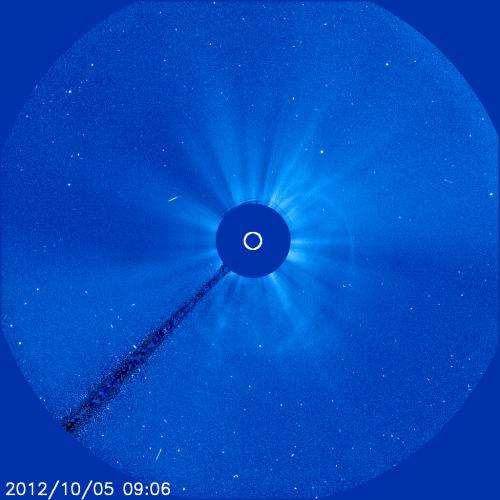
The Solar and Heliospheric Observatory (SOHO) captured this image of the sun at 5:06 a.m. EDT on Oct 5, 2012, showing a coronal mass ejection (CME) spreading away from the sun toward Earth. Credit: SOHO (ESA & NASA)

At 11:24 p.m. EDT on Oct. 4, 2012, the sun unleashed a coronal mass ejection (CME).

Not to be confused with a solar flare, which is a burst of light and radiation, CMEs are a phenomenon that can send into space and can reach Earth one to three days later.

Experimental NASA research models show the CME to be traveling at about 400 miles per second.

When Earth-directed, CMEs can affect electronic systems in satellites and on Earth. CMEs of this speed, however, have not generally caused major effects in the past. Further updates will be provided if needed.

Explore further: NASA sees sun unleash a wide, but benign, CME

add to favorites email to friend print save as pdf

Related Stories

NASA sees sun unleash a wide, but benign, CME

Sep 28, 2012

The sun erupted with a wide, Earth-directed coronal mass ejection (CME) on Sept. 27, 2012 at 10:25 p.m. EDT. CMEs are a phenomenon that can send billions of tons of solar particles into space that can reach ...

Moderate Labor Day solar flare eruption

Sep 07, 2011

At 9:35 PM ET on September 5, 2011, the sun emitted an Earth-directed M5.3 class flare as measured by the GOES satellite. The flare erupted from a region of the sun that appears close to dead center from Earth's ...

New solar active region spitting out flares

Jun 14, 2012

An active region on the sun, numbered AR 1504, rotated into view over the left side of the sun on June 10, 2012. The region fired off two M-class flares and two coronal mass ejections (CMEs) on June 13 and ...

Solar flares: What does it take to be X-class?

Aug 10, 2011

Solar flares are giant explosions on the sun that send energy, light and high speed particles into space. These flares are often associated with solar magnetic storms known as coronal mass ejections (CMEs). ...

Six coronal mass ejections in 24 hours

Sep 22, 2011

The sun let loose with at least six coronal mass ejections (CMEs) -- solar phenomena that can send solar particles into space and affect electronic systems in satellites -- from 7 PM ET on September 18, 2011 ...

NASA sees Sun send out mid-level solar flare

Jul 19, 2012

The sun emitted a mid-level solar flare on July 19, 2012, beginning at 1:13 AM EDT and peaking at 1:58 AM. Solar flares are gigantic bursts of radiation that cannot pass through Earth's atmosphere to harm ...

Recommended for you

Mars rover Opportunity examines clay clues in rock

May 18, 2013

(Phys.org) —NASA's senior Mars rover, Opportunity, is driving to a new study area after a dramatic finish to 20 months on "Cape York" with examination of a rock intensely altered by water.

NASA's STEREO detects a CME from the sun

May 17, 2013

On 5:24 a.m. EDT on May 17, 2013, the sun erupted with an Earth-directed coronal mass ejection or CME, a solar phenomenon that can send billions of tons of solar particles into space that can reach Earth ...

Nine-year-old Mars rover passes 40-year-old record

May 17, 2013

While Apollo 17 astronauts Eugene Cernan and Harrison Schmitt visited Earth's moon for three days in December 1972, they drove their mission's Lunar Roving Vehicle 19.3 nautical miles (22.210 statute miles ...

Bright explosion on the Moon

May 17, 2013

For the past 8 years, NASA astronomers have been monitoring the Moon for signs of explosions caused by meteoroids hitting the lunar surface. "Lunar meteor showers" have turned out to be more common than anyone ...

User comments : 5

Adjust slider to filter visible comments by rank

Display comments: newest first

barakn
not rated yet Oct 05, 2012
Since "solar particles" would be counted as radiation, trying to clarify the difference between a solar flare and a CME by stating one is a burst of radiation and the other solar particles is no clarification at all. Perhaps they could have written "electromagnetic radiation" instead of radiation. Also, there was a long duration solar flare which peaked during the CME. The CME did not appear to be a full halo CME, and I question whether it's newsworthy. CMEs are fairly common.
SteveL
not rated yet Oct 05, 2012
We were noticing the interference on our radios at work.
Cave_Man
not rated yet Oct 06, 2012
i cant wait for the days of a cell phone that measures air pollution, radiation levels, hazardous organisms etc etc. kinda like star trek. another 25 years and we will be living it.
alfie_null
not rated yet Oct 06, 2012
i cant wait for the days of a cell phone that measures air pollution, radiation levels, hazardous organisms etc etc. kinda like star trek. another 25 years and we will be living it.

The way the patent system is (ab)used today, you might well end up with only one brand capable of measuring radiation, another capable of detecting hazardous organisms, etc.
SteveL
not rated yet Oct 06, 2012
i cant wait for the days of a cell phone that measures air pollution, radiation levels, hazardous organisms etc etc. kinda like star trek. another 25 years and we will be living it.

The way the patent system is (ab)used today, you might well end up with only one brand capable of measuring radiation, another capable of detecting hazardous organisms, etc.
Ah, but then there are those who could care less about patent laws and will provide whatever technology is available, and for a discount price. Once the genie is out of the bottle, it has proven exceedingly difficult to put back in.

More news stories

Galaxy's Ring of Fire

Johnny Cash may have preferred this galaxy's burning ring of fire to the one he sang about falling into in his popular song. The "starburst ring" seen at center in red and yellow hues is not the product of ...

Fracking risks to ground water assessed

(Phys.org) —Extraction of "unconventional" gas from sedimentary rocks such as shale could provide a clean energy source and help some regions to become energy independent, but concerns have been raised ...