Sea sponges offer hope for new medicines
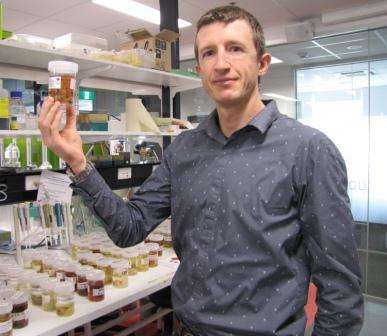
(Phys.org)—Flinders University researcher Dr Jan Bekker is on a mission to chemically fingerprint South Australia's marine sponges, with the wider aim of identifying new compounds that could ultimately play an important role in the fight against cancer and infectious diseases.
The Research Associate at Flinders Centre for Marine Bioproducts Development has discovered a large number of new chemicals from about 70 sea sponges, using a computer platform which distinguishes known compounds, which are common to all sponges, from those which have not yet been identified.
Marine sponges, which live in abundance in SA waters, constantly produce an array of different molecules as a natural defence mechanism against microorganisms and predators.
"Sea sponges are sedentary, they don't move around, so over millennia they have evolved a unique ability to produce chemicals to defend themselves from certain dangers in their environment including diseases and other animals," Dr Bekker said.
"Many of these chemicals have possible medical applications and diverse human health benefits," he said.
Using mass spectrometry, an analytical technique for determining the chemical structures of molecules, Dr Bekker is metabolically "fingerprinting" the chemicals before using computational methods to identify new compounds.
He said computational methods were also being used in combination with laboratory tests to predict anti-cancer and antibiotic properties in new sponges, with the ultimate aim to grow sponge cells in bioreactors to produce large amounts of the precious compounds.
"With thousands of different marine species in our waters containing many thousands of different compounds, the idea is to reduce the clutter of information and quickly zoom in on the unique chemicals that are functional and valuable, such as anti-cancer compounds," he said.
"This will reduce the cost and time needed for bioproduct discovery, enabling more discoveries to become commercially available products for human health, in a shorter amount of time."
More information: Dr Bekker will present his research at tomorrow's Australian Marine Sciences Association (SA Branch) 7th Annual Symposium and Annual General Meeting, which is sponsored by Flinders' Centre for Marine Bioproducts Development.
Provided by Flinders University


