Ontogenetic studies indicating the sternum formed differently in Enantiornithines and Ornithuromorphs
Oct 15, 2012
Ontogenetic studies indicating the sternum formed differently in enantiornithines and ornithuromorphs
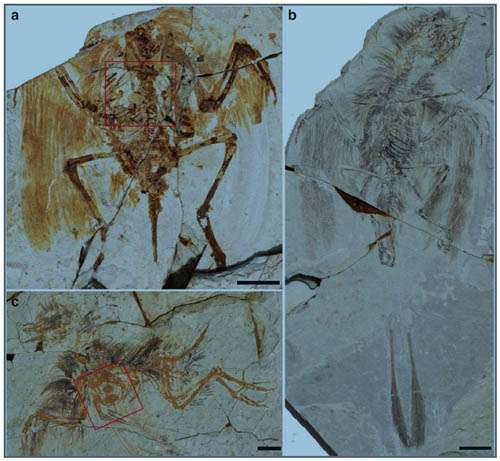
Fig.1: New juvenile specimens assigned to Enantiornithes indet. Credit: Jingmai O'Connor

In an article online October 9 in Nature Communications, researchers reveal, for the first time, the formation of the sternum in the largest group of Cretaceous birds, Enantiornithes, highlighting the importance of ontogenetic studies for understanding homology and the evolution of skeletal features in palaeontology.

The study is based on information from new juvenile specimens from the Shandong Tianyu Museum of Nature; these discoveries reveal rare ontogenetic information, in this case the ossification of the sternum, one of the most important elements in the bird skeleton (the two largest and most powerful flight muscles attach to this bone).

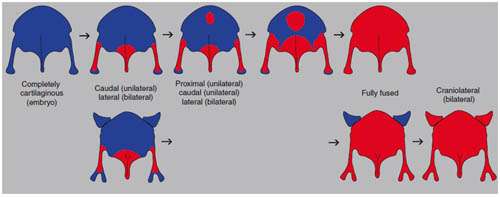
The study uncovers a major difference between the sternum in Enantiornithes and all other known groups of birds. The enantiornithine sternum forms from four to six ossification centers, three of which are recognized for the first time; the sternal body primarily forms from two non-symmetrical unilateral ossifications, the caudal of which ossifies first. In contrast, living birds ossify the sternal body from a mediolaterally symmetrical pair of sternal ossifications as in other , and ossifications proceeds from the front to the back.
Ontogenetic studies indicating the sternum formed differently in enantiornithines and ornithuromorphs
Fig.2: Interpretative drawing of the development of the enantiornithine sternum. Red indicates bone and blue indicates cartilage. Credit: Jingmai O'Connor

A number of similar features (e.g. ventral keel, caudal trabeculae, craniolateral processes) that distinguish the sterna of enantiornithines and ornithuromorphs (the group that includes living ) from other groups are now revealed to have very different developmental origins; this suggests these features are not fully homologous, highlighting the high degree of homoplasy that characterizes the dinosaur bird transition and the importance of development for testing hypotheses of homology.

This study suggests that many of the that unite Enantiornithes and Ornithuromorpha as sister-groups may represent parallelisms and through a better understanding of development, this relationship may no longer be supported.

Explore further: New finding further reduces morphological gap between two major avian groups

add to favorites email to friend print save as pdf

Related Stories

The skull of extinct birds revealed

Mar 21, 2011

Birds are the most diverse clade on the planet, and the skull of the living bird is one of the most highly modified and morphologically variable regions of their skeleton. The large diversity of enantiornithine ...

Archaeopteryx and the dinosaur-bird family tree

Sep 15, 2011

The magpie-sized Archaeopteryx had bird and dinosaur features and helped show that birds evolved from dinosaurs. However, recent research in the journal Nature questions its position in the dinosaur-bird family ...

Recommended for you

The ascent of man: Why our early ancestors took to two feet

May 24, 2013

A new study by archaeologists at the University of York challenges evolutionary theories behind the development of our earliest ancestors from tree dwelling quadrupeds to upright bipeds capable of walking and scrambling.

Submerged structure stumps Israeli archaeologists

May 23, 2013

The massive circular structure appears to be an archaeologists dream: a recently discovered antiquity that could reveal secrets of ancient life in the Middle East and is just waiting to be excavated.

User comments : 0

More news stories

Submerged structure stumps Israeli archaeologists

The massive circular structure appears to be an archaeologists dream: a recently discovered antiquity that could reveal secrets of ancient life in the Middle East and is just waiting to be excavated.

Mais non! French universities may teach in English

In France, there's a brewing debate over whether to speak anglais in universite. The National Assembly on Wednesday was taking up an education reform bill that would allow public universities to hold some courses—like science ...