Leaves of carob tree, source of chocolate substitute, fight food-poisoning bacteria
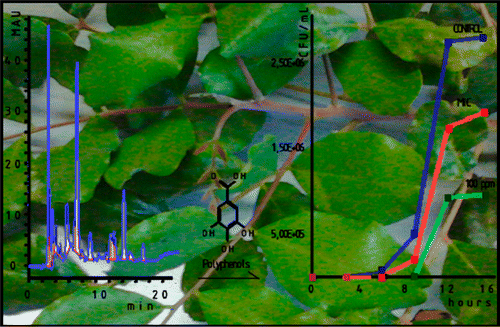
Leaves of the plant that yields carob—the substitute for chocolate that some consider healthier than chocolate—are a rich source of antibacterial substances ideal for fighting the microbe responsible for listeriosis, a serious form of food poisoning, according to a report in ACS' Journal of Agricultural and Food Chemistry.
Nadhem Aissani and colleagues explain that the increase in antibiotic-resistant bacteria has fostered a search for new natural substances to preserve food and control disease-causing microbes. They cite a need for new substances to combat Listeria monocytogenes, bacteria that caused food poisoning outbreaks in a dozen states with three deaths so far this year. Carob has attracted attention as a potential antibacterial substance, but until now, scientists had not tested it against Listeria. Carob may be best-known as a substitute for chocolate that does not contain caffeine or theobromine, which makes chocolate toxic to dogs.
Their report describes tests in which extracts of carob leaves proved effective in inhibiting the growth of Listeria bacteria growing in laboratory cultures. Further, it offers a possible explanation for the antibacterial action. The results were promising enough for the scientists to plan further tests of carob extracts on Listeria growing in meat and fish samples.
More information: "Inhibitory Effect of Carob (Ceratonia siliqua) Leaves Methanolic Extract on Listeria monocytogenes", J. Agric. Food Chem., 2012, 60 (40), pp 9954–9958, DOI: 10.1021/jf3029623
Abstract
In recent years, there has been great development in the search for new natural compounds for food preservation aimed at a partial or total replacement of currently popular antimicrobial chemicals. Carob (Ceratonia siliqua) offers a natural promising alternative for food safety and bioconservation. In this work, the methanolic extract of carob leaves (MECL) was tested for the ability to inhibit the growth of a range of microorganisms. MECL inhibited the growth of Listeria monocytogenes at 28.12 μg/mL by the broth microdilution method. The effect of this bacteriostatic concentration on the growth of this bacterium revealed a pattern of inhibition characterized by (a) a resumed growth phase, which showed a lower rate of growth if compared with controls; and (b) first a lag and then a stationary phase at a lower bacterium concentration. The study of the chemical composition of MECL by high-performance liquid chromatography and liquid chromatography/mass spectrometry showed the presence of gallic acid, (−)-epigallocatechin-3-gallate, myricitrin, isoquercitin, catechin, chlorogenic acid, and malic acid. L. monocytogenes growth inhibition was recorded for myricitrin and gallic acid at 450 μg/mL and for (−)-epigallocatechin-3-gallate and isoquercitin, respectively, at 225 and 112.5 μg/mL. Taking into account that proline is a ligand of proline dehydrogenase (PDH), the use of this compound leads us to hypothesize the mode of action of MECL constituents.
Journal information: Journal of Agricultural and Food Chemistry
Provided by American Chemical Society


