Satellite data confirms Santorini's growth
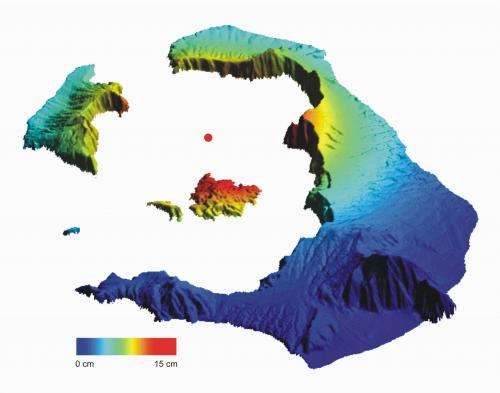
(Phys.org)—In the south Aegean Sea, the islands of Santorini have been showing signs of unrest for the first time in over half a century. Satellite data confirm that the islands have risen as much as 14 cm since January 2011.
The Santorini volcano's last major explosive eruption was about 3600 years ago. This event formed a large crater, or caldera, which is now flooded by the sea.
For the past 2000 years Santorini has shown different behaviour patterns, with small eruptions of lava every few tens or hundreds of years, slowly building a new volcanic edifice from the sea floor.
The Kameni islands, which lie in the middle of Santorini's large flooded crater, form the top of this youngest part of the volcano. The last eruption of the Kameni islands was in 1950. For the next 60 years, Santorini was quiet.
In January 2011, a series of small earthquakes began beneath the islands. Most were small enough that they could only be detected with sensitive seismometers, but several were felt by the local residents.
"On one particular day in April 2011, two tour guides told me they had felt an earthquake while they were on the volcano and that the motion of the ground had actually made them jump," said Michelle Parks, a PhD student working with a team of scientists to map Santorini's ground deformation.
"Locals working in restaurants on the main island of Thera became aware of the increase in earthquake activity through the vibration and clinking of glasses in their bars."
In a study published this week in Nature Geoscience, the team discovered that the whole island group has been inflating – slowly rising and moving outward – almost systematically around a point just north of the Kameni islands.
To map the movement, the scientists used radar data from ESA's Envisat satellite from March to December 2011 and from the German TerraSAR-X mission from July 2011 to April 2012.
To ensure accurate measurement, the team also used GPS receivers and an island-wide network of triangulation stations.
The study outlines that the total amount of vertical movement is now approaching 8–14 cm at some points on the Kameni islands, and the whole caldera is around 14 cm wider now than it was at the beginning of 2011.
The scientific team believes that molten rock has accumulated in a magma chamber at a depth of about 4 km.
This chamber increased by 10–20 million cubic metres (8–15 times the size of London's Olympic Stadium) from January 2011 to April 2012. As it grew, Earth's surface deformed in response.
The Kameni islands grow, on average, by about a million cubic metres per year. But the satellite data show that the amount of molten rock that has arrived beneath Santorini over the 12-month period is the equivalent of 10–20 years' growth of the volcano.
"People were obviously aware that something was happening to the volcano, but it wasn't until we saw the changes in the GPS, and the uplift on the radar images that we really knew that molten rock was being injected at such a shallow level beneath the volcano," said Juliet Biggs, a British scientist specialising in satellite radar and co-author of the paper.
"Many volcanologists study the rocks produced by old eruptions to understand what happened in the past, so it's exciting to use cutting-edge satellite technology to link that to what's going on in the volcanic plumbing system right now."
The scientists stressed that the recent movement doesn't indicate that an eruption is about to happen. In fact, the rate of earthquake activity has dropped off in the past few months.
Similar results of ground deformation on the islands have been observed by a Greek team from the Harokopio University of Athens using the same type of satellite data.
Another US–Greek team also had similar observations while using ground-based GPS instruments.
More information: Article: Evolution of Santorini Volcano dominated by episodic and rapid fluxes of melt from depth, doi:10.1038/ngeo1562
Journal information: Nature Geoscience
Provided by European Space Agency


