Daytime storms more likely to develop over drier soils
Sep 25, 2012
Daytime storms more likely to develop over drier soils
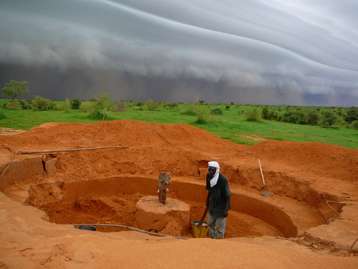
Arrival of a squall line (some storms sometimes form a front that can be hundreds of kilometers long, called a squall line). Credit: Françoise Guichard and Laurent Kergoat / CNRS

During the day, storms develop more frequently over drier land surfaces surrounded by wetter areas than elsewhere. This is the result of a study carried out by a European team represented in France by the National Center for Meteorological Research, using a statistical analysis of ten years' worth of satellite data covering every continent. According to the study, published on 12 September 2012 on the Nature website, current climate models do not reflect this phenomenon well and even frequently give opposite results, which is likely to flaw their scenarios for the development of drought. It would therefore seem important to take greater account of this phenomenon in models, so as to improve understanding of continental climate change at the regional scale.

Soil humidity affects the properties of the lower layers of the atmosphere, where clouds form. However, its role in triggering daytime storms is poorly understood. Now, a European team has discovered that there is a connection between soil humidity variations in a region and the storms that affect it. The researchers reached this conclusion by carrying out a highly detailed analysis of ten years' worth of for precipitation and soil humidity over the entire planet.   
Daytime storms more likely to develop over drier soils
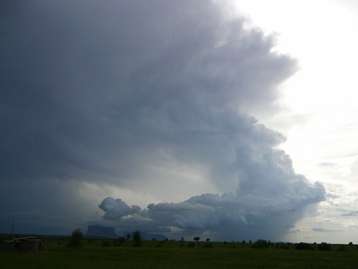
Storms developing. Credit: Françoise Guichard et Laurent Kergoat / CNRS

For each 150 km x 150 km area studied, the scientists first searched their high spatial (a few tens of kilometers) and temporal (a few hours) resolution for regions and dates where storms had developed. For these same places, they then noted the soil humidity in the hours preceding the storms and compared these values with those measured at the same time several tens of kilometers away.  

By using a statistical processing sytstem that corrects for characteristics specific to local climate, they observed that in continental regions, daytime storms develop more frequently over drier land surfaces surrounded by wetter areas than elsewhere. This trend is especially marked for the semi-arid soils of the Sahel and of Australia.
Daytime storms more likely to develop over drier soils
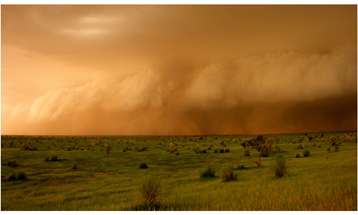
Arrival of a squall line (some storms sometimes form a front that can be hundreds of kilometers long, called a squall line). Credit: Françoise Guichard et Laurent Kergoat / CNRS

In addition, the researchers tested several used by the IPCC on a global scale. They discovered that the simulations carried out cannot reproduce the phenomenon observed by satellites. This defect is likely to flaw scenarios for the development of obtained using such models. In order to shed light on continental at the regional scale, it would therefore be important to take greater account of this phenomenon in models.

Explore further: Drier soils trigger more storms

More information: Afternoon rain more likely over drier soils. Taylor C. M., de Jeu R. A. M., Guichard F., Harris P. P., Dorigo W. A., Nature, on line 12 September 2012.

add to favorites email to friend print save as pdf

Related Stories

New data reveals how storms are triggered in the Sahel

Jun 21, 2011

In the Sahel, the frequency of storms increases when soil moisture varies over a few kilometers. Such contrasts cause air circulation between dry and humid areas, contributing to the development of storms. ...

Drier soils trigger more storms

Sep 12, 2012

Afternoon storms are more likely to develop when soils are parched, according to a new study published this week in Nature which examined hydrological processes across six continents.

Regional models expect drier, stormier western United States

Mar 31, 2012

As American southwestern states struggle against ongoing drought, and the Northwest braces for a projected shift from a snow- to a rain-dominated hydrological system, climate researchers strive to provide precipitation projections ...

Pollution alters isolated thunderstorms

Dec 15, 2009

New climate research reveals how wind shear -- the same atmospheric conditions that cause bumpy airplane rides -- affects how pollution contributes to isolated thunderstorm clouds. Under strong wind shear ...

New tool clears the air on cloud simulations

Oct 26, 2011

(PhysOrg.com) -- Climate models have a hard time representing clouds accurately because they lack the spatial resolution necessary to accurately simulate the billowy air masses.

Recommended for you

Alaska volcano shoots ash 15,000 feet into the air

May 18, 2013

(AP)—One of Alaska's most restless volcanoes has shot an ash cloud 15,000 feet into the air in an ongoing eruption that has drawn attention from a nearby community but isn't expected to threaten air traffic.

NASA sees Cyclone Mahasen hit Bangladesh

May 17, 2013

NASA's Tropical Rainfall Measuring Mission satellite known as TRMM measured Cyclone Mahasen's rainfall rates from space as it made landfall on May 16. Mahasen has since dissipated over eastern India.

Rapid climate change ruled out ice age trees

May 17, 2013

Short, sharp fluctuations in the Earth's climate throughout the last ice age may have stopped trees from getting a foothold in Europe and northern Asia, scientists say.

User comments : 0

More news stories

Heat-related deaths in Manhattan projected to rise

Residents of Manhattan will not just sweat harder from rising temperatures in the future, says a new study; many may die. Researchers say deaths linked to warming climate may rise some 20 percent by the 2020s, ...

Mice, gerbils perish in Russia space flight

A number of mice and eight gerbils sent into space in a Russian capsule destined to find out how well organisms can withstand extended flights perished during their journey, scientists said Sunday as the ...

Kinks and curves at the nanoscale

One of the basic principles of nanotechnology is that when you make things extremely small—one nanometer is about five atoms wide, 100,000 times smaller than the diameter of a human hair—they are going ...

Honeybees trained in Croatia to find land mines

(AP)—Mirjana Filipovic is still haunted by the land mine blast that killed her boyfriend and blew off her left leg while on a fishing trip nearly a decade ago. It happened in a field that was supposedly ...