Next on Mars: 400 scientists on an alien road trip
Imagine taking 400 scientists on an alien road trip where each one wants to examine every interesting rock along the way. Welcome to the next two years of NASA's landmark robotic mission on Mars.
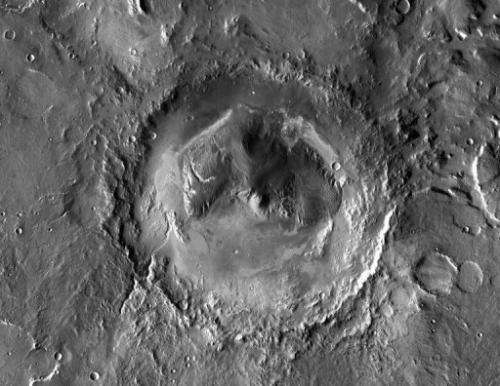
Scientists on Earth are eager to explore the Gale Crater, where water is believed to have pooled many years ago and where the US space agency's $2.5 billion Curiosity rover touched down early Monday.
Next up, Curiosity will haul the Mars Science Lab at least half-way up Mount Sharp, a towering three-mile (five-kilometer) Martian mountain with sediment layers that may be up to a billion years old.
But it may be a full year before the remote-controlled rover gets to the base of the peak, which is believed to be within a dozen miles (20 kilometers) of the rover's landing site.
"We are going to make sure that we are firing on all cylinders before we blaze out across the plains there," John Grotzinger, project scientist on the Mars Science Laboratory, told reporters shortly after the rover landed.
"Possibly within a year or so we could be at the base of Mount Sharp, because the place we landed on looks pretty darn interesting and we just don't want to rush out of there without having studied it real well."

First, a series of checks to the car-sized vehicle must take place, which could take weeks.
Then comes the unavoidable bickering and questions of, "Are we there yet?" that another NASA scientist likened to taking a cross-country family trip with all of his coworkers.
"My version of the surface mission is that it is like going on a family vacation and driving from here to Chicago," said Richard Cook, flight systems manager on the project at NASA's Jet Propulsion Laboratory in California.
"Except that your family has got 400 scientists who want to stop and look at every fossilized-whatever they can find."
Part of the check-out process will be testing the various instruments on board the rover, which carries everything from a rock-vaporizing laser and telescope combination to a chemistry kit for analyzing powdered soil and rock.
The rover also totes tools to check for carbon-based compounds that are the building blocks of life and a water detector that can pick up water underground at a distance of 20 inches (50 centimeters).
One instrument, the Radiation Assessment Detector (RAD), has already been collecting data about the radiation the spacecraft sustained, including the effects of five big solar flares, since its November 2011 launch.
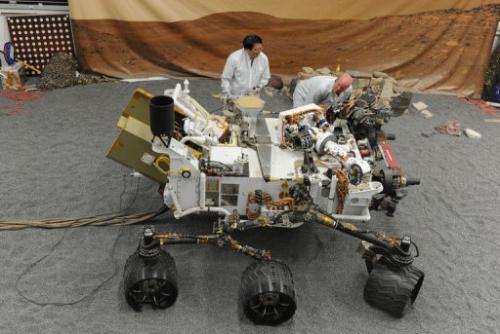
The monitor has tracked high energy atomic and subatomic particles from the sun that could pose a danger to astronauts if a human mission to Mars ever takes place, with President Barack Obama vowing to get humans there by 2030.
Dan Hassler, principal investigator for Curiosity's RAD, told reporters last week scientists were still analyzing the data but said the radiation recorded would make a "significant" contribution to an astronaut's career dose limit.
NASA also said that "radiation from galactic cosmic rays, originating from supernova explosions and other extremely distant events, accounted for more of the total radiation experienced on the trip than the amount from solar particle events."
The Curiosity rover's two year lifespan is already much longer than the last NASA rovers to get to the Red Planet in 2004.
Spirit and Opportunity were solar-powered vehicles meant to last three months. Spirit carried on a bountiful career that lasted more than six years and Opportunity is still trucking along.
"The nominal mission for this is two years, but I think if it lasts twice that I don't think anyone would be shocked," said Pete Theisinger, director of the Engineering and Science Directorate at the Jet Propulsion Laboratory.
"And that is the first time anyone has gotten me to say anything more than two years. We are in no hurry, OK? And we're not going to ... screw it up"
(c) 2012 AFP


