Study proves that one extinction leads to another
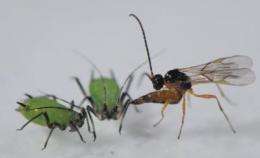
When a carnivore becomes extinct, other predatory species could soon follow, according to new research. Scientists have previously put forward this theory, but a University of Exeter team has now carried out the first experiment to prove it.
Published today (15 August 2012) in the Royal Society journal Biology Letters, the study shows how the demise of one carnivore species can indirectly cause another to become extinct. The University of Exeter team believes any extinction can create a ripple effect across a food web, with far-reaching consequences for many other animals.
The research adds weight to growing evidence that a 'single species' approach to conservation, for example in fisheries management, is misguided. Instead the focus needs to be holistic, encompassing species across an entire ecosystem.
The researchers bred two species of parasitic wasps, along with the two types of aphids on which each wasp exclusively feeds. They set up tanks with different combinations of the species and observed them for eight weeks. In tanks that did not include the first species of wasp, the second went extinct within a few generations. In tanks in which they co-existed, both wasp species thrived.
In the absence of the first wasp species, its prey grew in numbers. This threatened the other aphid, which the second wasp species attacks, eventually leading to its extinction. Both types of aphids feed on the same plants and there was not enough food for one to survive when the other thrived in the absence of its wasp predator.
Lead researcher Dr Frank van Veen of the University of Exeter's Centre for Ecology and Conservation said: "Our experiment provides the first proof of something that biologists have argued for a long time: predators can have indirect effects on each other, to the extent that when one species is lost, the loss of these indirect effects can lead to further extinctions. Although our study focused on insects, the principle would be the same for predators in any ecosystem, ranging from big cats on the African plains to fish in our seas.
"Our research highlights the fact that a 'single species' approach to conservation can be ineffective and even counter-productive. For example, protecting cod could lead to increased fishing pressure on other predatory fish which then, by the mechanism we have demonstrated here, could lead to further negative effects on the cod."
The experiment was designed by a team of University of Exeter scientists and second-year undergraduate students. The idea came about during a seminar, in which students were challenged to design an experiment that could prove the theory that predators have indirect effects on each other. The students were so inspired by the idea of proving a long-held theory that more than 30 of them volunteered to conduct the experiment with their lecturers.
Journal information: Biology Letters
Provided by University of Exeter


