Biodiversity protects tropical rainforests from drought
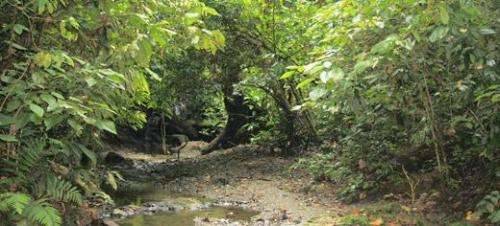
(Phys.org)—Forest carbon stocks in protected West African rainforests increased despite a 40-year drought, due to a dramatic shift in tree species composition.
The new study by Ghanaian and UK scientists, led by the University of Leeds, shows that biodiversity can limit the negative impacts of drought on forest carbon storage.
The researchers tracked over 10 000 trees in Ghanaian forests between 1990 and 2010, an extended period of water stress, showing that tree community composition shifted to favour species adapted to drier conditions. At the same time, the total amount of carbon stored in the trees of these forests actually increased.
Lead author Dr Sophie Fauset, a researcher from the School of Geography at the University of Leeds, said: "Tropical forests are valuable stores of carbon and biodiversity, but these stores are under threat given future increases in temperature and shifts in rainfall patterns. Short-term droughts cause high tree mortality and declines in forest carbon storage, but our results show that in response to longer-term droughts tropical forests can change their species composition, and maintain their overall forest carbon stocks."
The 40-year West African drought began in 1970 and has seen a reduction in the rainfall in the rainforest zone monitored in the study, by 11%, with a 23% reduction in the driest part of the year, compared to pre-1970 rainfall levels. The drought continues today. This is the largest long-term shift in rainfall anywhere in the tropics in the past 100 years.
Of course, there will be limits to the resilience of tropical forests to reductions in rainfall. "Very large reductions in rainfall will certainly cause these forests to change towards drier ecosystems and lower carbon stocks," Dr Fauset added. "In addition, not all tropical forests will necessarily respond in the same way. West African forests have experienced particularly large climatic changes and disturbances in the past, and such events may have led to a large number of species that are adapted to these conditions - other tropical forest regions may not show such resilience to drought."
Dr Tim Baker, also from the University of Leeds and a co-author of the paper, said: "The results from this study show the importance of biodiversity for understanding the response of tropical forests to global environmental change. In particular, the results suggest that efforts to conserve the carbon stocks of tropical forest landscapes to mitigate climate change also need to maintain their diverse range of species in order to maximise their resilience to future environmental change."
Dr Simon Lewis, a co-author who has worked on forest responses to Amazon droughts, added: "What's exciting about the results is that they suggest that if forests are well-protected and full of species they may be more resilient to drought than some models of rainforests predict for the future. Given that climate change will bring shocks to rainforests, conservation measures may well provide an added benefit as these forests will be more drought-shock resilient."
More information: 'Drought-induced shifts in the floristic and functional composition of tropical forests in Ghana' by Sophie Fauset, et al., is published online on 19 July 2012 in the journal Ecology Letters and can be found here: onlinelibrary.wiley.com/doi/10 … 012.01834.x/abstract
Journal information: Ecology Letters
Provided by University of Leeds


