Do the world's smallest flies decapitate tiny ants?
Jul 02, 2012
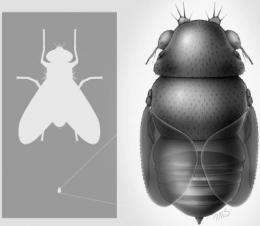
This is a reconstruction of the tiny phorid fly Euryplatea nanaknihali, with body size compared with a house fly (Musca domestica). Credit: © Inna-Marie Strazhnik

A new species of phorid fly from Thailand is the smallest fly ever discovered. At just 0.40 millimeters in length, it is 15 times smaller than a house fly and five times smaller than a fruit fly.

The tiny fly, Euryplatea nanaknihali, is also the first of its genus to be discovered in Asia, and it belongs to a fly family (Phoridae) that is known for "decapitating" ants.

Some species in the Phoridae fly family lay eggs in the bodies of ants, and the resulting feed in the ants' heads, eventually causing decapitation. In fact, some of these phorid flies are being used to try to control in the southern United Sates.

The new fly species is described in the July issue of in an article called "Small Size No Protection for Acrobat Ants: World's Smallest Fly Is a Parasitic Phorid (Diptera: Phoridae)".

According to the author, Dr. Brian Brown of the of Los Angeles County, these flies can probably decapitate some of the smallest ants in the world, ones with heads as small as 0.5 millimeters. Although this has not yet been observed, it is highly likely because the fly's only known relative, Euryplatea eidmanni, is known to parasitize ants in .

"It had always been assumed that smaller species of ants would be free from attack because it would be physically impossible for flies that are 1-3 millimeters in length to develop in their relatively tiny heads," he said. "However, here we show that even the smallest host ants in a host-parasitoid system cannot escape parasitism."

Explore further: City-life changes blackbird personalities, study shows

More information: http://dx.doi.org/10.1603/AN12011

add to favorites email to friend print save as pdf

Related Stories

New red imported fire ant enemies in place for combat

Jan 05, 2011

U.S. Department of Agriculture (USDA) scientists are releasing the fifth species of phorid fly to control fire ant populations. Red imported fire ants first arrived in the United States in the early 1930s ...

Angry wasps deal to their competitors

Mar 30, 2011

(PhysOrg.com) -- Scientists at Victoria University have identified a surprising and previously unknown behaviour in the animal world by studying interactions between native ants and invasive wasps in South Island beech forests.

Recommended for you

City-life changes blackbird personalities, study shows

15 hours ago

The origins of a young animal might have a significant impact on its behavior later on in life. Researchers at the Max Planck Institute for Ornithology in Radolfzell, Germany, have been able to demonstrate ...

Origins of 'The Hoff' crab revealed (w/ Video)

15 hours ago

The history of a new type of crab, nicknamed 'The Hoff' because of its hairy chest, which lives around hydrothermal vents deep beneath the Southern Ocean and Indian Ocean, has been revealed for the first ...

Personality test finds some mouse lemurs shy, others bold

20 hours ago

Anyone who has ever owned a pet will tell you that it has a unique personality. Yet only in the last 10 years has the study of animal personality started to gain ground with behavioral ecologists, said Jennifer ...

User comments : 0

More news stories

Surprise species at risk from climate change

(Phys.org) —Most species at greatest risk from climate change are not currently conservation priorities, according to an International Union for Conservation of Nature (IUCN) study that has introduced a ...

Origins of 'The Hoff' crab revealed (w/ Video)

The history of a new type of crab, nicknamed 'The Hoff' because of its hairy chest, which lives around hydrothermal vents deep beneath the Southern Ocean and Indian Ocean, has been revealed for the first ...

EUROnu project recommends building Neutrino Factory

(Phys.org) —The European Union's Seventh Framework Programme, EUROnu, has submitted its findings to a panel at CERN. Charged with choosing a project to study the nature of matter and antimatter, the project ...

'Ugly' finding: Unattractive workers suffer more

People who are considered unattractive are more likely to be belittled and bullied in the workplace, according to a first-of-its-kind study led by a Michigan State University business scholar.