Physicists achieve world's first violet nonpolar vertical-cavity laser technology
Jul 23, 2012
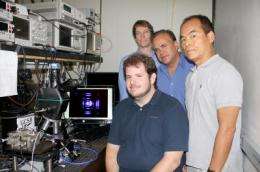
Shuji Nakamura and his research group at UCSB demonstrate the first violet nonpolar m-plane VCSEL based on gallium nitride. Pictured L to R: Casey Holder, Daniel Feezell (back), Steven DenBaars, Shuji Nakamura. Credit: UCSB College of Engineering

In a leap forward for laser technology, a team at University of California, Santa Barbara, has developed the first violet nonpolar vertical-cavity surface-emitting lasers (VCSELs) based on m-plane gallium nitride semiconductors.

This recent discovery by LED pioneer Shuji Nakamura and his research team at UCSB is an achievement in VCSEL technology that opens doors for higher optical efficiency lasers at greatly reduced manufacturing costs for a variety of applications.

"We have demonstrated working, electrically-injected nonpolar m-plane nitride VCSELs lasing at room temperature, and have shown that such devices are naturally polarization-locked along the crystallographic a-direction of the wurtzite crystal. This is in contrast to the majority of VCSELs, which are typically randomly polarized," said Dr. Daniel Feezell, project scientist with Nakamura's lab. Feezell directed the research effort with Nakamura and Steven DenBaars, Co-Directors of the and Energy Center at UCSB, and graduate student Casey Holder. Their findings have been submitted for publication.

"This is the first report of a nonpolar VCSEL, which we believe to be one of the biggest breakthroughs in the field of technology," explained Nakamura, a professor of Materials at UCSB. "The nonpolar VCSEL has a lot of advantages in comparison with conventional c-plane devices. One major advantage is that the light polarization is locked to one direction. This device could be used for a variety of applications, such as lighting, displays, sensors, and technology that requires and small form-factor."

VCSELs offer advantages over conventional edge-emitting for some applications. On-wafer testing of VCSEL arrays during the manufacturing process, for example, can save costs compared to edge-emitting lasers that require additional steps before they can be tested. VCSELs exhibit low threshold currents, circular and low divergence output beams, and are easily integrated into two-dimensional arrays.

The nonpolar VCSEL platform also provides high optical gain, which helps to increase optical efficiency of devices. "The nonpolar VCSEL could enable new products and applications, such as pico-projectors for smartphones, mobile cinema, or even automotive lighting," said DenBaars, professor of Materials.

"This breakthrough achievement by our Solid State Lighting and Energy Center leverages UCSB's globally recognized strength in materials science and engineering," commented Rod Alferness, Dean of the College of Engineering at UCSB. "The enhanced laser performance and prospects for significantly improved cost-effectiveness demonstrated is likely to have important impact on future generations of flat panel displays, mobile phones and lighting."

"Our UC Santa Barbara community is very proud of the continuing pioneering breakthroughs from the faculty and researchers at our Solid State Lighting and Energy Center," said Chancellor Henry T. Yang. "We congratulate our colleagues on this milestone achievement, which opens up exciting new opportunities for research and innovation."

Explore further: Optics: Statistics light the way

Related Stories

Conquering LED efficiency droop

Apr 30, 2012

WASHINGTON, April 30--Like a coffee enthusiast who struggles to get a buzz from that third cup of morning joe, light-emitting diodes (LEDs) seem to reach a point where more electricity no longer imparts the ...

Breakthrough Results in Laser Temperature Stability

May 02, 2004

Nanosemiconductor GmbH, an advanced facility for growth of nano-epitaxy wafers for semiconductor lasers, announced results achieved by Prof Bhattacharya’s group of the University of Michigan which demonstrates ...

Soraa LED light may dim 50-watt halogen rivals

Feb 09, 2012

(PhysOrg.com) -- Soraa, a Fremont, California company founded in 2008, this week launched its first product, a light that uses LEDS (light emitting diodes). The "Soraa LED MR16 lamp" is the "perfect" replacement ...

Recommended for you

Spheres can form squares

1 hour ago

Everybody who has tried to stack oranges in a box knows that a regular packing of spheres in a flat layer naturally leads to a hexagonal pattern, where each sphere is surrounded by six neighbours in a honeycomb-like ...

A quantum simulator for magnetic materials

17 hours ago

Physicists understand perfectly well why a fridge magnet sticks to certain metallic surfaces. But there are more exotic forms of magnetism whose properties remain unclear, despite decades of intense research. ...

Engineers pioneer flat spray-on optical lens

20 hours ago

A University of British Columbia engineer and a team of U.S. researchers have made a breakthrough utilizing spray-on technology that could revolutionize the way optical lenses are made and used.

Researchers forward quest for quantum computing

22 hours ago

Research teams from UW-Milwaukee and the University of York investigating the properties of ultra-thin films of new materials are helping bring quantum computing one step closer to reality.

User comments : 3

Adjust slider to filter visible comments by rank

Display comments: newest first

lbuz
not rated yet Jul 23, 2012
Given a unit spacing some even multiple of the emitted wavelength would it not be possible to develop an optical phased array, i.e..; multiple and/or steerable beams? If so then pico projectors mounted in front of the eye could 'paint' images directly on the retina(s). TVs and panel type displays could go the way of quadraphonic stereos.
Osiris1
1 / 5 (1) Jul 23, 2012
So Thaaats why da Men in Black wear dose coool glasses!
lbuz
not rated yet Jul 24, 2012
You may be wearing them soon. Note that the above is a question. An intelligent answer would have the benefit of being interesting and informative.

More news stories

Spheres can form squares

Everybody who has tried to stack oranges in a box knows that a regular packing of spheres in a flat layer naturally leads to a hexagonal pattern, where each sphere is surrounded by six neighbours in a honeycomb-like ...

A quantum simulator for magnetic materials

Physicists understand perfectly well why a fridge magnet sticks to certain metallic surfaces. But there are more exotic forms of magnetism whose properties remain unclear, despite decades of intense research. ...

Engineers pioneer flat spray-on optical lens

A University of British Columbia engineer and a team of U.S. researchers have made a breakthrough utilizing spray-on technology that could revolutionize the way optical lenses are made and used.

Researchers forward quest for quantum computing

Research teams from UW-Milwaukee and the University of York investigating the properties of ultra-thin films of new materials are helping bring quantum computing one step closer to reality.