NASA sees tropical fireworks in E. Pacific in newborn Tropical Storm Daniel
Jul 05, 2012
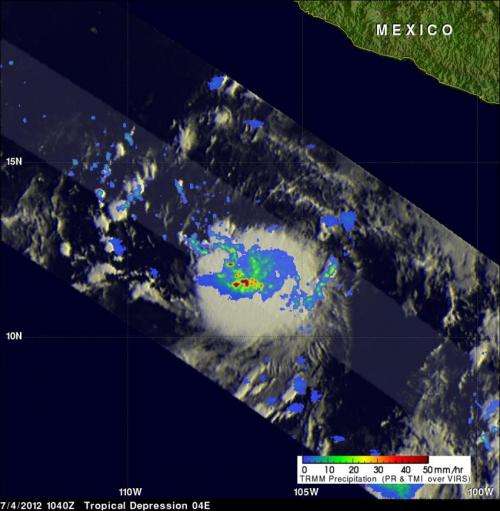
When NASA's TRMM satellite passed over TD 4E on July 4, 2012, it saw strong convective storms were dropping heavy rainfall (red) near the center of the tropical depression's center of circulation. That rain was falling at a rate of more than 2 inches/50 mm per hour. TRMM's Precipitation Radar (PR) instrument found that a few of these towering storms reached heights of about 15 km (~9.3 miles). Tropical Depression 4E has since strengthened into Tropical Storm Daniel. Credit: Credit: SSAI/NASA, Hal Pierce

Tropical "fireworks" happened in the eastern Pacific Ocean on July 4 as Tropical Depression 04E formed off western Mexico's coast and strengthened into Tropical Storm Daniel. NASA's Tropical Rainfall Measuring Mission (TRMM) satellite captured an image of TD 4E's rainfall and towering clouds as it passed overhead, and saw "hot towers" that suggested it would become a tropical storm.

The TRMM satellite got a very good look at recently formed Tropical Depression 4E (TD 4E) at 1040 UTC (6:40 a.m. EDT) on July 4, 2012. The hot towering cumulonimbus clouds called "hot towers" shooting up like a roman candle around the center of circulation provide the fireworks for the depression.

A "hot tower" is a rain cloud that reaches at least to the top of the troposphere, the lowest layer of the atmosphere. It extends approximately nine miles (14.5 km) high in the tropics. These towers are called "hot" because they rise to such altitude due to the large amount of latent heat. Water vapor releases this latent heat as it condenses into liquid.

Research by Owen Kelley and John Stout of George Mason University and NASA's Goddard Space Flight Center, Greenbelt, Md., shows that a tropical cyclone with a hot tower in its eyewall was twice as likely to intensify within the next six hours than a cyclone that lacked a tower and Tropical Depression 4E became Daniel by 11 a.m. EDT on July 5.

When TRMM passed over TD 4E, from TRMM's (TMI) and (PR) instruments revealed that strong convective storms were dropping heavy rainfall near the center of the tropical depression's center of circulation. TRMM's Precipitation Radar (PR) instrument found that a few of these towering storms reached heights of about 15 km (~9.3 miles). TRMM PR also found that rainfall within TD 4E was returning reflectivity values of over 51.5 dBZ. Those data provided additional proof that heavy was occurring within TD 4E.

At 5 p.m. EDT on July 4, the depression has maximum winds near 35 mph/55 kmh, and is about 445 miles (715 km) south-southwest of Manzanillo, Mexico. That's near 13.5 North and 107.8 West. It was moving to the west-northwest at 13 mph/20 kmh and headed away from land and out to sea.

At 11 a.m. EDT (8 a.m. PDT) on July 5, 2012, 4E became Danie with maximum sustained winds now near 45 mph (75 kmh). It was located near latitude 14.2 north and longitude 110.5 west. That's about 600 miles (970 km) south of the southern tip of Baja California. Daniel is moving toward the west-northwest near 12 mph (19 kmh). That general motion is forecast to continue, followed by a turn to the west, according to the National Hurricane Center.

Explore further: NASA sees a 'hot tower' in newborn eastern Pacific Tropical Depression 2E

add to favorites email to friend print save as pdf

Related Stories

TRMM satellite sees heavy rainfall in Tropical Storm Bud

May 23, 2012

Tropical Storm Bud is dropping heavy rainfall, and appears to be intensifying. NASA's Tropical Rainfall Measuring Mission (TRMM) satellite has been monitoring rainfall within the storm, and has watched it ...

TRMM satellite sees hot towers in Cyclone Koji

Mar 09, 2012

Hot towers, or towering thunderclouds that give off an excessive amount of latent heat, usually indicate a tropical cyclone will strengthen in six hours, and NASA's TRMM satellite saw some of them as it passed ...

TRMM sees post-season South Pacific Tropical Cyclone 21P

Jul 02, 2012

The South Pacific hurricane Tropical Depression season normally ends in April but Tropical Depression 21P has developed in the South Pacific Ocean between Papua New Guinea and the Solomon Islands from "System 91P," a low ...

Recommended for you

Alaska volcano shoots ash 15,000 feet into the air

May 18, 2013

(AP)—One of Alaska's most restless volcanoes has shot an ash cloud 15,000 feet into the air in an ongoing eruption that has drawn attention from a nearby community but isn't expected to threaten air traffic.

NASA sees Cyclone Mahasen hit Bangladesh

May 17, 2013

NASA's Tropical Rainfall Measuring Mission satellite known as TRMM measured Cyclone Mahasen's rainfall rates from space as it made landfall on May 16. Mahasen has since dissipated over eastern India.

Rapid climate change ruled out ice age trees

May 17, 2013

Short, sharp fluctuations in the Earth's climate throughout the last ice age may have stopped trees from getting a foothold in Europe and northern Asia, scientists say.

User comments : 0

More news stories

Heat-related deaths in Manhattan projected to rise

Residents of Manhattan will not just sweat harder from rising temperatures in the future, says a new study; many may die. Researchers say deaths linked to warming climate may rise some 20 percent by the 2020s, ...

Mice, gerbils perish in Russia space flight

A number of mice and eight gerbils sent into space in a Russian capsule destined to find out how well organisms can withstand extended flights perished during their journey, scientists said Sunday as the ...

Kinks and curves at the nanoscale

One of the basic principles of nanotechnology is that when you make things extremely small—one nanometer is about five atoms wide, 100,000 times smaller than the diameter of a human hair—they are going ...

Honeybees trained in Croatia to find land mines

(AP)—Mirjana Filipovic is still haunted by the land mine blast that killed her boyfriend and blew off her left leg while on a fishing trip nearly a decade ago. It happened in a field that was supposedly ...