NASA's Aqua Satellite sees Khanun's remnants dissipating over China
Jul 20, 2012
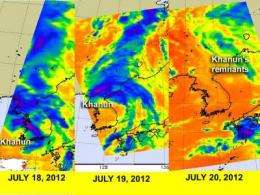
of the time series of infrared imagery from the AIRS instrument on NASA's Aqua satellite showing the progress of Tropical Depression Khanun before, during and after landfall on July 18, 19 and 20. Purple areas indicate coldest cloud top temperatures, strongest storms and heaviest rainfall. Credit: Credit: NASA JPL, Ed Olsen

NASA's Aqua satellite has been tracking the remnants of Tropical Depression Khanun, and infrared data revealed that it has moved over northeastern China where it is now dissipating.

NASA's Aqua satellite passed over Khanun on July 18, 19 and 20 and tracked the northeastern progression of the tropical cyclone after it made landfall. On Wednesday, July 18 at 1659 UTC (12:59 p.m. EDT/U.S.), Tropical Depression Khanun's center was still in the (west of South Korea). At that time, the Atmospheric Infrared Sounder (AIRS) instrument onboard NASA's Aqua satellite saw a band of thunderstorms with cloud top temperatures colder than 220 kelvin (-63.6 F/-53.1C) over western South Korea, bringing heavy rainfall. A larger area of thunderstorms with cloud top temperatures as cold as -63F/-53C were over western North Korea at that time, dropping moderate rainfall.

Khanun came ashore in western South Korea, bringing heavy rainfall with it on Thursday, July 19 as it moved in a north-northeasterly direction toward North Korea and northeastern China. On July 19 at 0405 UTC (12:05 a.m. EDT/U.S.), the heaviest rainfall and strongest thunderstorms appeared to be over the Kangnam Mountains in northern North Korea that also border eastern China. The Kangnam Mountains lie west of the Rangrim Mountains.

Although the center of Khanun's remnants moved into the , it was bringing some scattered showers and thunderstorms to a few areas in northeastern China on July 20. NASA's Aqua satellite passed over the region on July 20 at 0447 UTC (12:47 a.m. EDT) and showed some scattered showers moving east into Khabarovsk Krai, Russia, a federal subject of Russia. Khunan's remnants are expected to dissipate today.

Explore further: NASA sees Tropical Storm Khanun weakening for South Korea landfall

add to favorites email to friend print save as pdf

Related Stories

Tropical Depression Khanun blankets South Korea

Jul 19, 2012

Tropical Depression Khanun came ashore with some heavy rainfall in the morning hours (local time) on Thursday, July 19. NASA's Terra satellite captured an image of Khanun's clouds on July 19, covering all ...

Recommended for you

Alaska volcano shoots ash 15,000 feet into the air

5 hours ago

(AP)—One of Alaska's most restless volcanoes has shot an ash cloud 15,000 feet into the air in an ongoing eruption that has drawn attention from a nearby community but isn't expected to threaten air traffic.

NASA sees Cyclone Mahasen hit Bangladesh

16 hours ago

NASA's Tropical Rainfall Measuring Mission satellite known as TRMM measured Cyclone Mahasen's rainfall rates from space as it made landfall on May 16. Mahasen has since dissipated over eastern India.

Rapid climate change ruled out ice age trees

22 hours ago

Short, sharp fluctuations in the Earth's climate throughout the last ice age may have stopped trees from getting a foothold in Europe and northern Asia, scientists say.

Earth's iron core is surprisingly weak, researchers say

23 hours ago

The massive ball of iron sitting at the center of Earth is not quite as "rock-solid" as has been thought, say two Stanford mineral physicists. By conducting experiments that simulate the immense pressures deep in the planet's ...

User comments : 0

More news stories

Alaska volcano shoots ash 15,000 feet into the air

(AP)—One of Alaska's most restless volcanoes has shot an ash cloud 15,000 feet into the air in an ongoing eruption that has drawn attention from a nearby community but isn't expected to threaten air traffic.

Chinese, Indian airlines face EU pollution fines

Eight Chinese and two Indian airlines face fines of up to several million euros for not paying for their greenhouse gas emissions during flights within the bloc, the European Commission said on Friday.

Bright explosion on the Moon

For the past 8 years, NASA astronomers have been monitoring the Moon for signs of explosions caused by meteoroids hitting the lunar surface. "Lunar meteor showers" have turned out to be more common than anyone ...

US seizes Bitcoin operator accounts

US authorities seized the accounts of a Bitcoin digital currency exchange operator, claiming it was functioning as an "unlicensed money service business," court documents showed Friday.