30% of fish stocks overexploited: UN agency
Jul 09, 2012
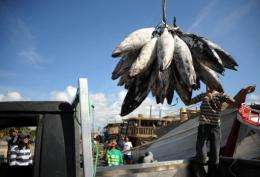
Indonesian workers load tuna fish from a fishing boat onto a truck at Benoa fishing port in Denpasar on Bali island. Almost 30 percent of fish stocks monitored by the UN's food agency are overexploited, undermining the crucial role sustainable fisheries play in providing food and jobs for millions, a report said Monday.

Almost 30 percent of fish stocks monitored by the UN's food agency are overexploited, undermining the crucial role sustainable fisheries play in providing food and jobs for millions, a report said Monday.

"Many of the marine fish stocks monitored by FAO remain under great pressure," the Rome-based Food and Agriculture Organisation (FAO) said in a statement accompanying its 2012 report on world fisheries.

"Almost 30 percent of these fish stocks are overexploited," said the agency, which is urging governments to make every effort to support around the world and rebuild overexploited stocks.

" not only causes negative , but it also reduces fish production, which leads to negative social and ," the report said.

The sector produced a record 128 million tonnes of fish for human food in 2012 through fisheries which provide a source of income for 55 million people.

"Fisheries and aquaculture play a vital role in the global, national and rural economy," said FAO head Jose Graziano da Silva. "The livelihoods of 12 percent of the world's population depend directly or indirectly on them."

But the sector faces an array of problems, including poor governance, weak regimes, conflicts over the use of natural resources and the persistent use of poor fishery and aquaculture practices, the report said.

"It is further undermined by a failure to incorporate priorities and rights of small-scale fishing communities and the injustices relating to gender discrimination and child labour," said Arni Mathiesen, FAO's Fisheries head.

Explore further: Bay Area thrushes nest together, winter together, and face change together

add to favorites email to friend print save as pdf

Related Stories

Action needed to keep fish on the menu in 2050

Apr 23, 2012

The latest study suggests we may still be able to eat as much fish as we do today 40 years from now. But for that to happen, we'll have to change our ways, say scientists.

Pacific fisheries face collapse by 2035: study

Oct 27, 2010

Pacific island fisheries face collapse in the next 25 years as overfishing, population growth and climate change threaten one of the region's main economic resources, a study warned Wednesday.

Recommended for you

Surprise species at risk from climate change

12 hours ago

(Phys.org) —Most species at greatest risk from climate change are not currently conservation priorities, according to an International Union for Conservation of Nature (IUCN) study that has introduced a ...

African black slug serves as healthy reminder

14 hours ago

A new, invasive species of slug found recently in South Texas serves as a good reminder to thoroughly wash fruits and vegetables before eating them, according to an expert with the Texas A&M AgriLife Extension ...

User comments : 0

More news stories

Snail genetic tracks reveal ancient human migration

Some snails in Ireland and the Pyrenees are genetically almost identical, perhaps because they were carried across the Atlantic during an 8000-year-old human migration. The snail genetics tie in with studies ...