DARPA successfully tests gigapixel-class camera
Jul 06, 2012

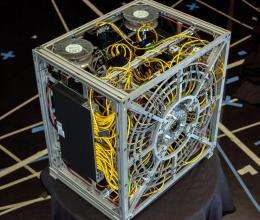
This is an image of a gigapixel camera currently being developed by DARPA’s Advanced Wide FOV Architectures for Image Reconstruction and Exploitation (AWARE) program.

As part of the program, DARPA successfully tested cameras with 1.4 and 0.96 gigapixel resolution at the Naval Research Lab in Washington, DC.

The gigapixel cameras combine 100-150 small cameras with a spherical objective lens. Local aberration correction and focus in the small cameras enable extremely high resolution shots with smaller system volume and less distortion than traditional wide field lens systems.

The effort hopes to produce resolution up to 10 and 50 gigapixels—much higher than the human eye can see. Analogous to a parallel-processor supercomputer, the AWARE design uses parallel multi-scale micro cameras to form a wide field panoramic image.

The AWARE program is developing new approaches and advanced capabilities in imaging to support a variety of Department of Defense missions. For more information, please visit the program page.

Explore further: Engineers build 50 gigapixel camera

add to favorites email to friend print save as pdf

Related Stories

Engineers build 50 gigapixel camera

Jun 20, 2012

By synchronizing 98 tiny cameras in a single device, electrical engineers from Duke University and the University of Arizona have developed a prototype camera that can create images with unprecedented detail.

Advanced infrared capabilities enable today’s warfighter

Feb 22, 2012

By carrying a more accurate rifle scope, U.S. warfighters can increase their standoff distance when engaging enemies. Increased standoff distance can help protect warfighter lives. This is especially true when an infrared ...

A 360 degree camera that sees in 3D (w/ Video)

Dec 01, 2010

Surround sight has come to the camera. Inspired by the eye of a fly, EPFL scientists have invented a camera that can take pictures and film in 360° and reconstruct the images in 3D.

Recommended for you

GPS solution provides 3-minute tsunami alerts

May 17, 2013

Researchers have shown that, by using global positioning systems (GPS) to measure ground deformation caused by a large underwater earthquake, they can provide accurate warning of the resulting tsunami in ...

Innovative concrete to facilitate building rehabilitation

May 16, 2013

The Structural Technology Group of the Universitat Politècnica de Catalunya, BarcelonaTech (UPC), in collaboration with the company PROMSA, is participating in the rehabilitation of the Gaudí House Museum in Barcelona's P ...

User comments : 3

Adjust slider to filter visible comments by rank

Display comments: newest first

GSwift7
not rated yet Jul 06, 2012
Ahhh, that's cool. I want one. Can I have one?

Realistically, there's no reason that a scaled down version of this idea couldn't be introduced in consumer cameras. Composite focus and aperature would be something people would pay extra for I bet. And, if people are willing to pay for it, it will eventually be sold.
Yogaman
not rated yet Jul 07, 2012
Much more information is at Duke's project site: http://disp.duke....s/AWARE/

"Realistically, there's no reason that a scaled down version of this idea couldn't be introduced in consumer cameras."

Well, starting from 300 mm by 300 mm and 588 watts, it's gotta scale down quite a bit. Unless you mean to a single micro-camera, in which case it's now available.
GSwift7
not rated yet Jul 09, 2012
Well, starting from 300 mm by 300 mm and 588 watts, it's gotta scale down quite a bit. Unless you mean to a single micro-camera, in which case it's now available


Yes, scaled down by a couple of orders of magnitude. There's no need for such resolution. I was thinking in terms of the posibility to individually adjust exposure and focus for different parts of a picture and then use the above technology for patching together the mozaic of individual images to form a complete image. That software is really the most challenging part of creating such a composite image. It's not easy to seamlessly join multiple images together without losing image quality and/or creating visual artefacts.

More news stories

German energy shift faces headwinds

Tense engineers have their eyes peeled on complex colour-coded diagrams on a wall-sized screen that makes their control room look like the inside of a spaceship.

China police billions spell profit opportunity

Mannequins in riot gear, armoured cars and drones line a police equipment and "anti-terrorism technology" trade fair in Beijing as vendors seek to profit from China's huge internal security budget.

Internet in 'coma' as Iran election looms

Iran is tightening control of the Internet ahead of next month's presidential election, mindful of violent street protests that social networkers inspired last time around over claims of fraud, users and ...

Russia retrieves mice, newts from space

A Russian capsule filled with 45 mice and 15 newts along with other small animals returned from a month's mission in orbit on Sunday with data scientists hope will pave the way for a manned flight to Mars.

Honeybees trained in Croatia to find land mines

(AP)—Mirjana Filipovic is still haunted by the land mine blast that killed her boyfriend and blew off her left leg while on a fishing trip nearly a decade ago. It happened in a field that was supposedly ...

Galaxy's Ring of Fire

Johnny Cash may have preferred this galaxy's burning ring of fire to the one he sang about falling into in his popular song. The "starburst ring" seen at center in red and yellow hues is not the product of ...