CU-Boulder student investigates biochar for water treatment in developing countries
(Phys.org) -- A variety of public health issues plague the refugees from Burma living on the Thai border, not the least of which is drinking water contaminated by bacteria and pesticides. Yet few low-cost, sustainable and appropriate treatment technologies are available to people in rural and developing communities to ensure water safety.
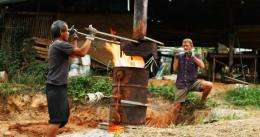
University of Colorado Boulder doctoral student Joshua Kearns may have a solution involving a 4,000-year-old technology -- filtering water through charcoal -- made more robust through intensive research and development. He just returned from six months in northern Thailand where he conducted field work on gasification methods for making sustainable, locally generated “biochar” from common agricultural residues such as corn cobs, sugar cane, bamboo and wood pruned from orchards.
Kearns believes that biochar can be developed as a low-cost surrogate for activated charcoal that is commonly used to remove synthetic organic contaminants from drinking water through the surface binding process known as adsorption. His doctoral work at CU-Boulder is focused on optimizing a process for heating biomass in small- to intermediate-scale gasifier devices, such as household cookstoves and farm-scale production units, to produce an effective char product with low emissions that is better than charcoal produced from traditional kilns.
“Nobody has studied this, and there are actually millions of people who could benefit from it,” says Kearns, a West Virginia native. After earning a master’s degree in environmental chemistry, he went looking for a university where he could focus on low-tech, appropriate solutions for people in developing countries.
He says he found a good fit with CU-Boulder’s Engineering for Developing Communities Program and the water quality work being done by Professor R. Scott Summers in the civil, environmental and architectural engineering department. He also has been working with Professor Detlef Knappe at North Carolina State University as his co-adviser. Summers and Knappe are both widely recognized as world leaders in the field of activated carbon research and application in water treatment.
“I think we’re better positioned to look at how biochar could be used to improve water quality than anyone else in the world,” Kearns said.
Kearns has six years of experience working in Thailand to improve environmental systems. He went there to immerse himself in sustainable community development and founded the nonprofit Aqueous Solutions, which consults on various projects to improve health and livelihood security in Southeast Asia through sustainable design and appropriate technology, particularly in the water-sanitation-hygiene sector.
The Pun Pun Center for Self-Reliance in the Chiang Mai Province of Thailand provides a base for his experimental testing and other operations. Kearns was an intern at the Pun Pun farm in 2006, when he started to look at biochar as a low-cost water treatment alternative for people in rural Southeast Asia.
As part of this effort, Kearns has published a series of online handbooks and instructional videos on water treatment using biochar adsorbents. The materials are currently available at www.aqsolutions.org in English and Thai, and they are being translated into other Southeast Asian languages.
“My philosophy is to empower people to use their resources sustainably and solve problems for themselves,” he said.
To date, Kearns’ work has been supported by CU-Boulder in the form of a Chancellor’s Fellowship for Research, a grant from the Engineering Excellence Fund and a Beverly Sears Graduate Student Grant. He also has received external support from the American Water Works Association, the iBoP Asia Partnership for Science and Technology Innovation and the Charles A. and Anne Morrow Lindbergh Foundation.
In the fall, he will begin a three-year tenure as a Science To Achieve Results (STAR) Research Fellow supported by the U.S. Environmental Protection Agency.
Provided by University of Colorado at Boulder


