NASA reveals heaviest rainfall in Tropical Storm Talim's southwestern side
Jun 18, 2012
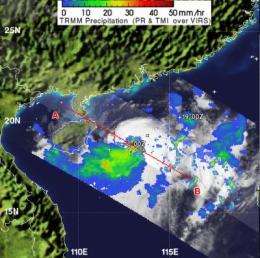
NASA's TRMM satellite captured a look at rainfall occurring in newborn Tropical Storm Talim in the South China Sea on June 18, 2012 at 0331 UTC. Areas in blue and green represent light to moderate rainfall, falling at a rate between 0.78 and 1.5 7inches (20-40 mm) . The bulk of the rainfall was occurring on the southern and western quadrants of the storm Credit: Credit: NASA/SSAI, Hal Pierce

Tropical Storm Talim was born today in the South China Sea, and NASA's TRMM satellite noticed the heaviest rainfall in the storm is occurring in the south and western quadrants of the storm. NASA's Aqua Satellite noticed that some of Talim's rainfall is reaching Vietnam.

NASA's Measuring Mission (TRMM) satellite captured a look at rainfall occurring in newborn Tropical Storm Talim in the South China Sea on June 18, 2012 at 0331 UTC. Areas in blue and green represent light to moderate rainfall, falling at a rate between 0.78 and 1.5 7inches (20-40 mm). Some of the thunderstorms near the center of circulation were approaching 10 kilometers (6.2 miles) high.
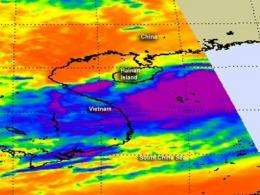
NASA's Aqua satellite passed over Talim on June 18 at 0617 UTC (2:17 a.m. EDT), and captured infrared data about its cloudtop temperatures. Data showed that the western quadrant of the storm extended over Vietnam, bringing some rainfall there today, June 18. The strongest thunderstorms, however, were still off-shore at the time, where cloud top temperatures (purple) exceeded -63F (-52C), and that's where the heaviest rainfall was occurring. Credit: Credit: NASA/JPL, Ed Olsen

NASA's Aqua satellite passed over Talim on June 18 at 0617 UTC (2:17 a.m. EDT), and captured about its cloudtop temperatures. Data showed that the western quadrant of the storm extended over Vietnam, bringing some rainfall there today, June 18.

The strongest thunderstorms, however,

were still off-shore at the time, where cloud top temperatures exceeded -63F (-52C), and that's where the heaviest rainfall was occurring.

Forecasters expect that today's brush with Vietnam will be its only encounter with that country, as Talim is now heading northeast, and toward Taiwan. On June 18, 2012 at 1200 UTC (8 a.m. EDT/U.S.) were near 45 knots (52 mph/83 kph). Talim was crawling to the northeast at 3 knots (3.4 mph/5.5 kph) and is currently 185 nautical miles (213 miles/342.6 km) south-southwest of Hong Kong.

in the South China Sea are warm enough to keep Talim going and forecasters expect Talim to strengthen on its journey to the northeast. Talim is expected to reach the Taiwan Strait in two days.

Explore further: Astonishing hi-resolution satellite views of the destruction from the Moore, Oklahoma tornado

add to favorites email to friend print save as pdf

Related Stories

NASA sees Tropical Storm Sanvu continue to intensify

May 23, 2012

Two NASA satellites have provided infrared and rainfall data that has shown Tropical Storm Sanvu continues to intensify as it heads toward Iwo To, Japan. NASA's Tropical Rainfall Measuring Mission (TRMM) satellite ...

Ыatellite gets two tropical cyclones in one shot

Jun 23, 2011

The Northwestern Pacific Ocean is active with two tropical cyclones today, Tropical Storm Meari near the Philippines, and Tropical Depression Haima moving over China and now toward Vietnam. NASA's Aqua satellite ...

Recommended for you

Strong earthquake at exceptional depth

17 hours ago

This morning at 05:45 CEST, the earth trembled beneath the Okhotsk Sea in the Pacific Northwest. The quake, with a magnitude of 8.2, took place at an exceptional depth of 605 kilometers. Because of the great ...

Marine forecasting on the horizon for Indian Ocean Rim

17 hours ago

Nearly all of the member countries of the Indian Ocean Rim Association for Regional Cooperation (IOR-ARC) will attend the week-long workshop to further cooperation and understanding on international ocean ...

Russia evacuates drifting Arctic research station

May 23, 2013

Russia has ordered the urgent evacuation of the 16-strong crew of a drifting Arctic research station after ice floe that hosts the floating laboratory began to disintegrate, officials said Thursday.

User comments : 0

More news stories

Galaxies fed by funnels of fuel

(Phys.org) —Computer simulations of galaxies growing over billions of years have revealed a likely scenario for how they feed: a cosmic version of swirly straws.

Dark, massive asteroid to fly by Earth on May 31

It's 1.7 miles long. Its surface is covered in a sticky black substance similar to the gunk at the bottom of a barbecue. If it impacted Earth it would probably result in global extinction. Good thing it is ...

Source of life running out: water scientists

The majority of people on Earth people will face severe water shortages within a generation or two if pollution and waste continues unabated, scientists warned at a conference in Bonn Friday.

Google eyes emerging markets networks

Google has become deeply involved in a series of projects to build and operate wireless networks in emerging markets including sub-Saharan Africa and Southeast Asia, a report said Friday.