NASA eyeing southern Gulf of Mexico low for tropical trouble
Jun 21, 2012
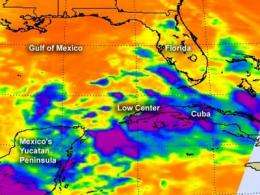
NASA's Aqua satellite AIRS instrument captured this infrared image of a low in the southern Gulf of Mexico on June 21 at 3:29 a.m. EDT. The strongest thunderstorms (purple) have high, cold cloud tops (of -63F/-52C)located southwest and southeast of the center. Credit: NASA/JPL, Ed Olsen

NASA satellites are providing data on a broad area of low pressure in the south-central Gulf of Mexico that has a medium chance for development into a tropical depression.

Infrared data from the Atmospheric Infrared Sounder (AIRS) instrument that flies onboard NASA's Aqua satellite is helping forecasters at the National Hurricane Center understand what's happening with the low pressure area. In an image captured on June 21 at 0729 (3:29 a.m. EDT), the center of the low pressure area appears to be near the western tip of Cuba near 22 North and 85 West. The strongest thunderstorms and convection (rising air that forms the thunderstorms) have high, cold cloud tops (of -63F/-52C) that indicate strong uplift, southwest and southeast of the center.

The National Hurricane Center noted that the large area of clouds, showers and thunderstorms extend from the northwestern north into the southeastern Gulf of Mexico and over Florida.

There are currently strong upper level winds that have been inhibiting development, but those winds are expected to weaken, giving the low more of a chance to get organized. The low continues to move north into the bringning heavy rainfall and possible flooding over Mexico's Yucatan Peninsula, western Cuba and southern Florida over the next couple of days.

Explore further: Scientists: Soggy British weather likely to stay

add to favorites email to friend print save as pdf

Related Stories

Frigid cloud top temperatures show Hurricane Dora's power

Jul 20, 2011

Extremely cold cloud top temperatures in thunderstorms are an indication of the strength they possess, and infrared satellite data from NASA revealed a large area of very cold and powerful thunderstorms around ...

Recommended for you

Siberian caves warn of permafrost meltdown

18 hours ago

Climate records captured in Siberian caves suggest 1.5 degrees of warming is enough to trigger thawing of permafrost, according to a paper to be given at the Geological Society of London on 27 June.

User comments : 0

More news stories

Metamorphosis of moon's water ice explained

Using data gathered by NASA's Lunar Reconnaissance Orbiter (LRO) mission, scientists believe they have solved a mystery from one of the solar system's coldest regions—a permanently shadowed crater on the ...

Looking at sachet water consumption in Ghana

Many of West Africa's largest cities continue to lag in their provision of piped water to residents. Filling the service gap are plastic water sachets, which have become an important source of drinking water ...

LA to give every student an iPad; $30M order

Los Angeles' school system, the second largest in the United States, is ordering iPads for all its students, handing Apple a major success in its quest to make the tablet computer a replacement for textbooks.