James Webb space telescope's mirrors get 'shrouded'
Jun 07, 2012 By Laura Betz

(Phys.org) -- Earlier this year, NASA completed deep-freeze tests on the James Webb Space Telescope mirrors in a "shroud" at the X-ray & Cryogenic Facility (XRCF) at Marshall Space Flight Center in Huntsville, Ala.

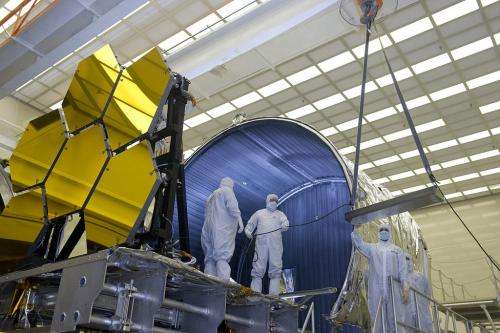
All of the Webb's 18 main were tested under conditions that they will experience when operating in to verify they will work as expected. Tested in batches of six, the mirrors were transferred to the cryogenic testing chamber where they were plunged to a chilly -414 degrees Fahrenheit (-248 C). In the photo above, a batch of mirror segments sit on a stand that was placed inside a helium-cooled "shroud." The base of the shroud is visible in the lower left. The part that looks like a swing is a counterbalance weight for the crane that lifted the fully populated test stand into place.

"The large tube is the back of the helium shroud that will go around the mirrors and cool them," says Lee Feinberg, the Optical Telescope Element Manager for the at the Goddard Space Flight Center in Greenbelt, Md., "The gaseous helium shroud sits inside of a liquid nitrogen shroud…which sits inside of a vacuum chamber. All three work together to create a vacuum and cold environment to test the mirrors."

That cold environment mimics the harsh cold of space. Once at sub-zero temperatures, the testing team measured the surface shape of the mirror segments to see how they performed at cryogenic temperatures. The team measured the mirror segments by using laser systems to illuminate them for reflection of the light back into a sensor. The sensor then measures the change in shape of the mirror as the temperature changes.

When fully deployed, the Webb's mirror will be over six times larger than that of the Hubble Space Telescope’s mirror. It's designed to look farther away and further back in time, and will be able to detect light from distant galaxies.

But despite Webb’s size, its segmented beryllium mirror technology is significantly lighter than Hubble’s one-piece glass mirror technology. Each of the 18 hexagonal, gold-coated primary mirror segments is hollowed out and ribbed on the backside, which Feinberg explains ”lightweights” them to reduce their mass while keeping their precise shape.

Explore further: NASA head views progress on asteroid lasso mission

add to favorites email to friend print save as pdf

Related Stories

Recommended for you

NASA head views progress on asteroid lasso mission

2 hours ago

Surrounded by engineers, NASA chief Charles Bolden inspected a prototype spacecraft engine that could power an audacious mission to lasso an asteroid and tow it closer to Earth for astronauts to explore.

Ecuador satellite collides with Russian space junk

2 hours ago

A small Ecuadoran satellite collided in orbit with the remains of a Russian rocket, but it is too soon to know how much damage it might have sustained, Quito's space agency said Thursday.

Forecast for Titan: Wild weather could be ahead

May 22, 2013

(Phys.org) —Saturn's moon Titan might be in for some wild weather as it heads into its spring and summer, if two new models are correct. Scientists think that as the seasons change in Titan's northern hemisphere, ...

SDO observes mid-level solar flare

May 22, 2013

UPDATE 16:30 p.m. EDT: The M7-class flare was also associated with a coronal mass ejection or CME, another solar phenomenon that can send billions of tons of particles into space. While this CME was not Ea ...

User comments : 0

More news stories

Hubble reveals the ring nebula's true shape

(Phys.org) —The Ring Nebula's distinctive shape makes it a popular illustration for astronomy books. But new observations by NASA's Hubble Space Telescope of the glowing gas shroud around an old, dying, ...

NASA head views progress on asteroid lasso mission

Surrounded by engineers, NASA chief Charles Bolden inspected a prototype spacecraft engine that could power an audacious mission to lasso an asteroid and tow it closer to Earth for astronauts to explore.

A hidden population of exotic neutron stars

(Phys.org) —Magnetars – the dense remains of dead stars that erupt sporadically with bursts of high-energy radiation - are some of the most extreme objects known in the Universe. A major campaign using ...

Controlling mood through the motions of mitochondria

(Medical Xpress)—Regulating the distribution of power in neurons is done by a system that makes the national electric grid look simple by comparison. Each neuron has several thousand mitochondria confined ...

Google Drive sports new view and scan enhancements

(Phys.org) —Google Drive has a new look and functions. The makeover in Google Drive features scanning and interface enhancements that put the user into "card" mode. The enhancements make it easy for the ...

Future doctors unaware of their obesity bias

Two out of five medical students have an unconscious bias against obese people, according to a new study by researchers at Wake Forest Baptist Medical Center. The study is published online ahead of print in the Journal of ...