Looking for the next American hyrax?
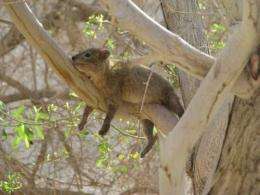
If popular karaoke bars and the long audition lines for American Idol demonstrate anything, it's that people like to express themselves through song — and the bigger the audience, the better. Now researchers at Tel Aviv University have found the same trait in small, rodent-like mammals called hyraxes, indigenous to Africa and the Middle East.
According to Prof. Eli Geffen and PhD candidate Amiyaal Ilany of TAU's Department of Zoology, hyrax vocalizations or "songs" go a long way towards communicating the singer's unique identity. Each one has unique songs that communicate a variety of information such as the singer's age, social rank, hormone levels, and size. And preliminary data suggests that the hyraxes prefer to sing when they have a more alert audience, taking the opportunity to promote themselves.
Understanding the function of the hyrax song will shed new light on animal communications, says Prof. Geffen, who notes that while birds are well known in the animal kingdom for singing, more complex vocalizations are rare in mammals. It's a model for learning how animals emit and receive signals, and what they understand from these communication channels, adds Ilany.
Their research, done in collaboration with Dr. Lee Koren of the University of Calgary and Adi Barocas of the University of Wyoming, and has been published in a number of journals including PLoS ONE and Behavioral Ecology and Sociobiology.
Playing to the audience
A wealth of information is encoded in a hyrax song, which can continue for five to 10 minutes at a time.Identity, age, hormone levels, or social rank have the capacity to alter the songs, explain the researchers, who have been studying the same hyrax population for the last 13 years at the Ein Gedi nature reserve near the Dead Sea. "The long duration is a major strength of this project because we now know a lot about each individual animal," explains Ilany, including the details of their birth, life history, and social standing. "We can recognize this information encoded in song because we know them that well."
Using vocalization to signify identity is not without precedent. Many animals have the ability to identify another individual member of the same species by sound, say the researchers, because vocal sounds are unique to the individual that makes them. Flamingo mothers returning to the colony recognize their chicks by sound, for example. And of course humans can, too —recognizing the voice on the other end of the telephone before the caller introduces himself.
Beyond the information that is being communicated in the song itself, the function, context, and reception of the song are also significant. Singing hyraxes, who are almost exclusively male, are more likely to sing when they have an alert audience to listen to them. Prof. Geffen believes that perhaps the hyraxes use singing as a tool to promote themselves and facilitate communication with the other hyraxes.
Call and response?
In some cases, another male hyrax will respond with a song of its own, says Ilany. The researchers are now working to discover exactly what prompts this two-way communication. They are in the process of conducting "playback" experiments in which recorded hyrax songs are played to groups of hyraxes to see if different messages elicit different listener responses. For example, is a song that communicates a high social ranking more likely to get a response? The researchers are also testing the success of these self-advertisements by measuring whether hyraxes that sing in specific ways have higher success rates in finding mates and siring offspring.
There are still many questions left to answer, say the researchers, noting that many research groups around the world are attempting to decode animal communication systems. Eventually the aim is to create a "big picture" of how vocal communication works in this system, says Prof. Geffen, whose research has already gone a long way towards understanding communication in the animal world.
Journal information: PLoS ONE , Behavioral Ecology and Sociobiology
Provided by Tel Aviv University


