Project to examine 'Yeti' DNA
May 23, 2012
Project to examine 'Yeti' DNA
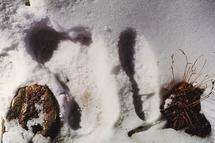
Unexplained footprint (left) found in the Himalayas in 1976 by René de Milleville. Credit: Wikimedia.

(Phys.org) -- A new collaboration between Oxford University and the Lausanne Museum of Zoology will use the latest genetic techniques to investigate organic remains that some have claimed belong to the ‘Yeti’ and other ‘lost’ hominid species.

The Oxford-Lausanne Collateral Hominid Project invites institutions and individuals with collections of cryptozoological material (cryptozoology: the search for animals whose existence is not proven) to submit details of the samples they hold, and then on request submit the samples themselves, particularly hair shafts, for rigorous genetic analysis. The results will then be published in peer-reviewed scientific journals.

Ever since Eric Shipton’s 1951 Everest expedition returned with photographs of giant footprints in the snow there has been speculation that the Himalayas may be home to large creatures ‘unknown to science’. Since then, there have been many eye-witness reports of such creatures from several remote regions of the world. They are variously known as the ‘’ or ‘migoi’ in the Himalaya, ‘bigfoot’ or ‘sasquatch’ in America, ‘almasty’ in the Caucasus mountains and ‘orang pendek’ in Sumatra, as well as others.

Professor Bryan Sykes, a Fellow of Wolfson College, Oxford, who will lead the project with Michel Sartori, Director of the Lausanne Museum of , said: "Theories as to their species identification vary from surviving collateral hominid species, such as Homo neanderthalensis or Homo floresiensis, to large primates like Gigantopithecus widely thought to be extinct, to as yet unstudied primate species or local subspecies of black and brown bears.

"Mainstream science remains unconvinced by these reports both through lack of testable evidence and the scope for fraudulent claims. However, recent advances in the techniques of genetic analysis of organic remains provide a mechanism for genus and identification that is unbiased, unambiguous and impervious to falsification."

These techniques were not available to biologists like Dr. Bernard Heuvelmans, whose 1955 book Sur la Piste des Betes Ignorees (translated into English as On the Track of Unknown Animals) helped foster widespread public interest in the subject. Between 1950 and 2001, the year of his death, Dr. Heuvelmans, as well as investigating numerous claims, assembled a considerable archive that is now curated by the Museum of Zoology in Lausanne, Switzerland.

Professor Sykes said: "It is possible that a scientific examination of these neglected specimens could tell us more about how Neanderthals and other early hominids interacted and spread around the world."

Explore further: Honeybees trained in Croatia to find land mines

Related Stories

Puffins 'scout out' best migration route

Jul 21, 2011

(PhysOrg.com) -- Individual Atlantic puffins 'scout out' their own migration routes rather than relying on genetic ‘programming’ or learning routes from a parent, a new study suggests.

35,000 new species 'sitting in cupboards'

Dec 07, 2010

(PhysOrg.com) -- Of 70,000 species of flowering plants yet to be described by scientists, more than half may already have been collected but are lying unknown and unrecognised in collections around the world, ...

All viruses 'can be DNA stowaways'

Nov 19, 2010

(PhysOrg.com) -- 'Fossil viruses' preserved inside the DNA of mammals and insects suggest that all viruses, including relatives of HIV and Ebola, could potentially be ‘stowaways’ transmitted from ...

Supernova 'brightens up' September 7-8

Sep 08, 2011

(PhysOrg.com) -- The nearest supernova of its type to be discovered for 40 years is predicted to be at its brightest 7-8 September and will be visible through a good pair of binoculars.

Reeling in a wild silk harvest

May 17, 2011

(PhysOrg.com) -- A new way of treating wild silkmoth cocoons could see new silk industries springing up wherever wild silk is found in Africa and South America, as well as silk?s Asian heartland.

Recommended for you

Lovelorn frogs bag closest crooner

1 hour ago

What lures a lady frog to her lover? Good looks, the sound of his voice, the size of his pad or none of the above? After weighing up their options, female strawberry poison frogs (Oophaga pumilio) bag th ...

Honeybees trained in Croatia to find land mines

19 hours ago

(AP)—Mirjana Filipovic is still haunted by the land mine blast that killed her boyfriend and blew off her left leg while on a fishing trip nearly a decade ago. It happened in a field that was supposedly ...

Front-row seats to climate change

May 17, 2013

By day, insects provide the white noise of the South, but the night belongs to the amphibians. In a typical year, the Southern air hangs heavy from the humidity and the sounds of wildlife.

User comments : 2

Adjust slider to filter visible comments by rank

Display comments: newest first

indio007
1 / 5 (2) May 23, 2012
Nothing is impervious to falsification.
DavidW
1 / 5 (2) May 23, 2012
Nothing is impervious to falsification.


Truth and Life are. There may be attempts, but the truth that we cannot change the past remains, as does the most important thing in life is life, as the most important self-evident truth.

More news stories

Lovelorn frogs bag closest crooner

What lures a lady frog to her lover? Good looks, the sound of his voice, the size of his pad or none of the above? After weighing up their options, female strawberry poison frogs (Oophaga pumilio) bag th ...

Why we need to put the fish back into fisheries

Overfishing has reduced fish populations and biodiversity across much of the world's oceans. In response, fisheries are increasingly reliant on a handful of highly valuable shellfish. However, new research by the University ...

Engineered microbes grow in the dark

Scientists at the University of California, Davis have engineered a strain of photosynthetic cyanobacteria to grow without the need for light. They report their findings today at the 113th General Meeting of the American ...

Honeybees trained in Croatia to find land mines

(AP)—Mirjana Filipovic is still haunted by the land mine blast that killed her boyfriend and blew off her left leg while on a fishing trip nearly a decade ago. It happened in a field that was supposedly ...

ER docs are key to reducing health care costs

Emergency physicians are key decisionmakers for nearly half of all hospital admissions, highlighting a critical role they can play in reducing health care costs, according to a new report from the RAND Corporation.