Virginia Tech announces 2012 football helmet ratings; 2 more added to the 5-star mark
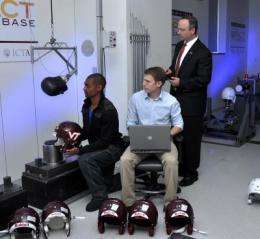
Virginia Tech released today the results of its 2012 rating for adult football helmets that is designed to assess a helmet's ability to reduce the risk of concussion. A total of three helmets achieved a "5 star" mark, which is the highest rating awarded by the Virginia Tech Helmet Ratings™. In addition to the Riddell Revolution Speed, which was the only helmet to receive 5 stars last year, the Rawlings Quantum Plus and Riddell 360 also earned 5 stars as the best available helmets.
The process used for evaluating the head protector involves performing 120 impacts on each helmet model at multiple locations and impact energies. To date, the Virginia Tech Helmet Ratings™ for adult football include 15 helmet models that were evaluated using more than 2000 laboratory tests. The ratings, first introduced in 2011, utilize the STAR Evaluation System to assess helmet performance. The STAR, an acronym for the Summation of Tests for the Analysis of Risk, evaluation system was developed using data collected from over 1.8 million head impacts experienced by football players throughout an eight-year span.
"This is a perfect example of a National Institutes of Health (NIH) funded project resulting in translational research. The NIH supported the development of the sensors and data collection that provided the foundation for our rating system. Specifically, you can see Riddell and Rawlings using this research to develop the very best helmets," said project director Stefan Duma, the Harry C. Wyatt Professor and Department Head of the Virginia Tech – Wake Forest School of Biomedical Engineering and Sciences (SBES).
A total of five new adult football helmet models by Rawlings, Riddell, and Xenith have been released since the Virginia Tech Helmet Ratings™ were first made available in 2011. The Riddell 360 (5 stars), Rawlings Quantum Plus (5-stars), Rawlings Impulse (4-stars), and Rawlings Quantum (4 stars) were new models that are recommended by the researchers. "We recommend any of the 4 or 5 star helmets for players. The specific helmet a player chooses will be dependent on other factors such as a fit and comfort," said Duma. The remaining new helmet model included in the 2012 ratings was the Xenith X2, which earned a 3 star rating.
Seven helmets are now rated with 4 stars in the 2012 Virginia Tech Helmet Ratings™: Schutt ION 4D, Schutt DNA Pro+, Rawlings Impulse, Xenith X1, Riddell Revolution, Rawlings Quantum, and Riddell Revolution IQ. The remaining five football helmet models were rated with 3 stars or less. The complete ratings are publicly available online www.SBES.vt.edu/nid so that consumers can make educated decisions when purchasing football helmets.
"The three lowest rated helmets from last year are now all off the market. It is encouraging to see this positive shift towards better head protection," said Steven Rowson, assistant professor of biomedical engineering at Virginia Tech. Rowson was responsible for the development of the STAR Evaluation System and testing of the helmets. "Four of the five new helmet models introduced in the last year earned a 4 or 5 star rating. This helps demonstrate that a data-driven approach can be utilized to optimize helmet design to reduce concussion risk," he said.
In the future, the researchers will expand the Virginia Tech Helmet Ratings™ to include other sports as well as youth football helmets. To this end, Duma and his team collected the first dataset on head impacts experienced by youth football players last year. In the fall of 2012, researchers at Virginia Tech and Wake Forest will expand this dataset by instrumenting over 300 youth football players from ages 6 to 18 in what is called the KIDS study (Kinematics of Impact Data Set). "As we learn more about youth head impact exposure, we can begin to develop methods to evaluate youth-specific helmet designs," Duma added.
The Virginia Tech Helmet Ratings are independent of any helmet manufacturer and utilized funding from private donations, the School of Biomedical Engineering and Sciences, and the Institute for Critical Technology and Applied Science. Detailed downloadable reports that outline the methodology and resulting data are available on the web site. As noted on the data sheets, any player may sustain a concussion with even the best equipment, Duma said.
Provided by Virginia Tech


