SLAC X-ray laser used to probe biomolecules to individual atoms
May 31, 2012
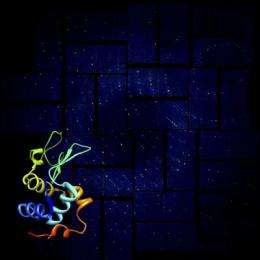
This rendering shows a lysozyme structural model against its X-ray diffraction pattern from SLAC National Accelerator Laboratory’s Linac Coherent Light Source (LCLS), a powerful X-ray laser facility. Researchers have achieved high-resolution images of these simple biomolecules using advanced crystallography at LCLS. This successful demonstration paves the way for studies of more complex biological structures. Credit: Anton Barty/DESY

An international team led by SLAC National Accelerator Laboratory has proved how the world's most powerful X-ray laser can assist in cracking the structures of biomolecules, and in the processes helped to pioneer critical new investigative avenues in biology.

The team's experiments, reported this week in Science, used SLAC's (LCLS) to obtain ultra-high-resolution views of crystallized , including a small protein found in egg whites called lysozyme.

For decades, scientists have reconstructed the shape of and proteins by illuminating crystallized samples with X-rays to study how they scatter the light. The team's work with lysozyme represents the first-ever high-resolution experiments using serial femtosecond -- the split-second imaging of tiny crystals using ultrashort, ultrabright X-ray .

The technique utilized a higher resolution than previously achieved using X-ray lasers, allowing scientists to use smaller crystals than typical with other methods, and could also enable researchers to view in a way never before possible.

This video is not supported by your browser at this time.
The ultimate goal of the CXI instrument is to perform imaging of single biological molecules as depicted in a simplistic manner in this movie. The single LCLS pulses travel to the CXI location in the Far Experimental Hall, where a simplified CXI instrument is shown, with a sample injector delivering single biomolecules to the LCLS beam. As we zoom in, we can see the molecules being hit by the LCLS beam, which destroys them, but not before the scattered X-rays are on their way to the detector, allowing a diffraction pattern from an undamaged molecule to be recorded. The individual diffraction patterns are recorded and stacked into the computer memory. Each image, coming from a different random orientation is then classified into bins corresponding to the orientation of the molecule. The different classes of orientations are averaged together and then the full 3D pattern is assembled. Once the 3D pattern is known, phase retrieval techniques allow the 3D atomic structure of the biomolecules to be deduced from the diffracted intensities alone. Credit: SLAC National Accelerator Laboratory

"We were able to actually visualize the structure of the molecule at a resolution so high we start to infer the position of individual atoms," said Sébastien Boutet, a staff scientist at LCLS who led the research.

"Not only that, but the structure we observed matches the known structure of lysozyme and shows no significant sign of radiation damage, despite the fact that the pulses completely destroy the sample. This is the first high-resolution demonstration of the 'diffraction-before-destruction' technique on biological samples, where we're able to measure a sample before the powerful pulses of the LCLS damage it," he added.

The team chose lysozyme as the first sample for their research because it is easy to crystallize and has been extensively studied. Their work not only determined lysozyme's structure at such high resolution that it showed individual amino acids, but also proved the ability to use extremely small crystals for a range of applications. Boutet says the team has also studied more complex proteins and systems that they are analyzing now.
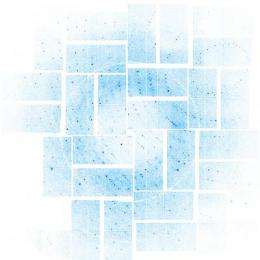
This is a colored X-ray diffraction image of a lysozyme micro crystal, recorded at the X-ray free-electron laser LCLS. Credit: A. Barty/DESY

Ultimately, scientists using LCLS are driving toward an atomic- and molecular-scale understanding of complex biological systems -- such as the membrane proteins that are critical in cell functions and the mechanisms that power photosynthesis -- which could lead to discoveries in a range of sciences, from pharmaceutical breakthroughs to new sources of alternative energy.

The experiment was the first study performed on the new Coherent X-ray Imaging (CXI) instrument, a "molecular camera" designed, built and commissioned by SLAC and now available to the scientific community. Also key to the study was a novel custom-made detector, the Cornell-SLAC Pixel Array Detector (CSPAD), developed in collaboration between Cornell University and SLAC for use at the CXI instrument.

"This important demonstration shows that the technique works, and it paves the way for a lot of exciting experiments to come," says Boutet.

Explore further: Breakthrough calls time on bootleg booze

More information: "High-Resolution Protein Structure Determination by Serial Femtosecond Crystallography," by S. Boutet; Science, 2012.

Journal reference: Science search and more info website

Provided by SLAC National Accelerator Laboratory

5 /5 (4 votes)

Related Stories

FLASH Imaging Redux: Nano-Cinema is Born

Jul 08, 2008

Flash imaging of nanoscale objects undergoing ultrafast changes is now a technical possibility, according to a recent paper published in the June 22 edition of Nature Photonics. The results are a direct precur ...

First atomic X-ray laser created

Jan 25, 2012

Scientists working at the U.S. Department of Energy's (DOE) SLAC National Accelerator Laboratory have created the shortest, purest X-ray laser pulses ever achieved, fulfilling a 45-year-old prediction and ...

First Test of New X-ray Laser Strips Neon Bare

Sep 18, 2009

(PhysOrg.com) -- It takes a lot of energy to strip all ten electrons from an atom of neon. Doing it from the inside out, knocking away the most-closely-held, innermost electrons first, is an even rarer feat. ...

LCLS offers new method for examining membrane proteins

Mar 15, 2012

Many membrane proteins serve as gateways in and out of the cell. Because they act as “traffic control” for infectious agents and disease-fighting drugs, they are the targets of more than 60 percent ...

Fastest X-ray images of tiny biological crystals

Jan 05, 2012

(PhysOrg.com) -- An international research team headed by DESY scientists from the Center for Free-Electron Laser Science (CFEL) in Hamburg, Germany, has recorded the shortest X-ray exposure of a protein crystal ...

Recommended for you

Breakthrough calls time on bootleg booze

18 hours ago

(Phys.org) —Using a laser, the St Andrews scientists can now carry out detailed analysis of a spirit sample no bigger than a teardrop and can even confirm whether it is toxic or not. It's hoped the testing ...

Bringing life into focus

May 17, 2013

Spinning-disk confocal microscopy is an optical imaging technique that can be used to generate detailed three-dimensional fluorescence images of living cells and their contents. Although a powerful tool for ...

World's smallest droplet

May 17, 2013

(Phys.org) —Physicists may have created the smallest drops of liquid ever made in the lab. That possibility has been raised by the results of a recent experiment conducted by Vanderbilt physicist Julia Velkovska and her ...

User comments : 0

More news stories

Lab sets a new record for creating heralded photons

(Phys.org) —Entanglement, by general consensus of physicists, is the weirdest part of quantum science. To say that two particles, A and B, are entangled means that they are actually two parts of an inseparable ...

Competition in the quantum world

Innsbruck physicists led by Rainer Blatt and Peter Zoller experimentally gained a deep insight into the nature of quantum mechanical phase transitions. They are the first scientists that simulated the competition ...

Breakthrough calls time on bootleg booze

(Phys.org) —Using a laser, the St Andrews scientists can now carry out detailed analysis of a spirit sample no bigger than a teardrop and can even confirm whether it is toxic or not. It's hoped the testing ...

New principle may help explain why nature is quantum

Like small children, scientists are always asking the question 'why?'. One question they've yet to answer is why nature picked quantum physics, in all its weird glory, as a sensible way to behave. Researchers ...

Child maltreatment increases risk of adult obesity

Children who have suffered maltreatment are 36% more likely to be obese in adulthood compared to non-maltreated children, according to a new study by King's College London. The authors estimate that the prevention or effective ...

New immune system discovered

(Medical Xpress)—A research team, led by Jeremy Barr, a biology post-doctoral fellow, unveils a new immune system that protects humans and animals from infection.