NOAA near-term weather forecasts get powerful boost from new computer model
Starting today, NOAA is using a sophisticated new weather forecast computer model to improve predictions of quickly developing severe weather events including thunderstorms, winter storms and aviation hazards such as clear air turbulence.
The Rapid Refresh now provides NOAA's most rapidly updated weather forecast, replacing an older model that served a similar function. The Rapid Refresh, developed by NOAA's Earth System Research Laboratory in Boulder, Colo. and NOAA's National Centers for Environmental Prediction (NCEP) in Camp Springs, Md., updates every hour with a new forecast extending out 18 hours for North America. Such forecasts are especially important in aviation, where fast-developing weather conditions can affect safety and efficiency, but they are equally important for severe weather and energy-related forecasting.
"When accurate and timely weather modeling is needed most, the new Rapid Refresh model delivers," said Louis Uccellini, Ph.D., director, NOAA's National Centers for Environmental Prediction, a part of NOAA's National Weather Service. "This new tool ensures that forecasts are the best they can be by using the latest science and computer techniques in an effort to create a more Weather-Ready Nation."
The United States is the only country in the world that updates computer model forecasts every hour using the latest observations from an extensive network of ground- and satellite-based sensors, radars and aircraft, said Stan Benjamin, lead developer of the new model and a research meteorologist at the Earth System Research Laboratory.
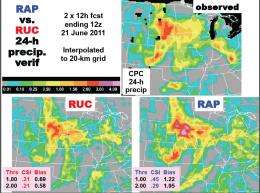
The new model was tested extensively, running experimentally for 22 months at NOAA's NCEP, and will replace the older rapidly updated model, Rapid Update Cycle (RUC), which was run at similar frequency and resolution for an 18-hour forecast. But in comparisons with the older model, the new Rapid Refresh (RAP) has proved more skillful. "Overall, RAP provides equal or better forecasts than its predecessor for all variables, from winds to precipitation," Benjamin said.
For example, the new model performed significantly better than its predecessor in forecasting heavy rain that pounded the Midwest in June last year. For comparison, the new forecasts more correctly projected the geographical areas that received 2 inches or more of precipitation.
RAP's skillful forecasts derive from three key improvements over the earlier model:
- RAP is based on a significantly more advanced numerical weather prediction model, the Weather Research and Forecasting (WRF) model. WRF was created through a collaboration of NOAA, the National Center for Atmospheric Research, the Air Force Weather Agency and dozens of other research institutions;
- RAP uses an innovative technique for "assimilating" current observations used to start the forecast model. The newer assimilation technique, developed through a NOAA-NASA research partnership led by NOAA's NCEP, improves short-range forecasts; and
- RAP extends the geographical coverage of NOAA's weather situational awareness information to all of North America, not just the contiguous U.S. as was the case for the older model.
The addition of Alaska, where air travel is common, is particularly important. "The majority of Alaska is not connected to a road network, so the only means of transportation to many locations is by air," said Gene Petrescu, science and technology transfer meteorologist at NOAA's National Weather Service in Anchorage, Alaska. "We are hearing from our forecast offices that they see value in these hourly forecasts."
Provided by NOAA National Marine Fisheries Service


