Iowa State students take a lighter, more autonomous 'lunabot' to NASA competition
May 21, 2012
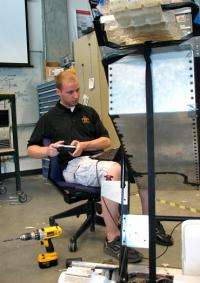
Chris Walck, a member of Team LunaCY and a graduate student in mechanical engineering, operates the student-designed and student-built lunar excavator during a recent session in the team's campus shop. Larger photo. Credit: Mike Krapfl

Jared Peterson, working away in the Caterpillar Mechatronics Laboratory in Iowa State University's Hoover Hall, recently held up a small electric motor.

See the ? said the senior from Lake Lillian, Minn., who's studying . They're supposed to be copper colored, not black and charred.

"Little things like this happen," Peterson said of the burned-up motor. "It's part of the learning process."

And so Team LunaCY, an Iowa State student club dedicated to designing and building robots for NASA's Lunabotics Mining Competition, still has some last-minute work to do. The team will pack up its $25,000 project on Saturday and head for the in Florida. This year's competition is May 21-26.

Student teams from 58 universities - including 20 international schools - have been designing, building and testing excavating robots that dig, scoop and collect a dusty, abrasive mix that simulates . The goal is to mine and deposit at least 10 kilograms of the moon dirt within 10 minutes. Points are also awarded for dust tolerance, communications, robot weight, power requirements and autonomous operation.

Ben McNeill, who just graduated with a degree in mechanical engineering and is project director for Team LunaCY, said Iowa State's third entry in the annual contest is a step up.

"It's a lot better robot," he said. "It's more efficient, yet it's able to mine more material than last year's robot."
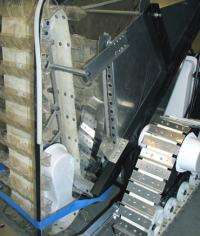
Team LunaCY's robot is designed to scoop up simulated lunar soil. Larger photo. Credit: Mike Krapfl

Major improvements include aluminum construction rather than steel, cutting the robot's weight in half. The robot is also loaded with sensors - including some built into the bumpers - that will allow the robot to drive and operate on its own.

Chris Walck, a graduate student in mechanical engineering from Urbandale, has been leading the development of the electronic and control systems for this year's robot.

He admits to be a little nervous heading into competition.

"It's problem-solving time," he said. "We're kind of in the Plan D phase right now on a couple of things. But we're doing all right, better than we have in the past."

And while building a that collects moon dust may sound like a far-fetched project for the 25 students on Team LunaCY, Walck said he's gaining some experience he can apply to his new engineering job.

"This has been a really good learning experience," he said. "A lot of the problems we have worked on here have been very practical."

Explore further: Congress gets mixed advice on regulating drones

add to favorites email to friend print save as pdf

Related Stories

Robots Playing Shuffleboard (w/ video)

Jun 08, 2011

(PhysOrg.com) -- Intense robot battles have, for the most part, been confined to the silver screen. Occasionally a robot comes by to trounce us at chess, but robot on robot competition has been fairly limited. ...

UBC engineering students unveil moon dust-shoveling robot

Oct 12, 2009

(PhysOrg.com) -- A robot designed by UBC students will be shoveling moon dust at an international robotics competition next week, vying for a $500,000 prize and the opportunity to contribute to NASA's future space exploration ...

iMobot modular robot technology licensed

Jul 12, 2011

The University of California, Davis has signed an exclusive license agreement with Barobo, Inc. of West Sacramento, Calif., to commercialize the modular robot technology called "iMobot" – an Intelligent ...

iMobot rolls, crawls and creeps

Mar 24, 2011

An intelligent, reconfigurable modular robot invented by a UC Davis alumnus and a professor of mechanical and aerospace engineering is headed for commercial development with the help of a grant from the National ...

Recommended for you

NEC phone is liquid-cooled and gender-specific

1 hour ago

(Phys.org) —Pink is the color of princess fairy-tale gowns, magic slippers, upscale cupcake icing, and everything else favorable to girls who just want to be girls. "Ladyphones" appear to be concepts for ...

Expectations high for next Xbox

3 hours ago

It's almost time for a new Xbox. Eight years have passed since Microsoft unveiled the Xbox 360, double the amount of time between the original Xbox debut in 2001 and its high-definition successor's launch ...

Congress gets mixed advice on regulating drones

May 17, 2013

(AP)—The growing use of unmanned surveillance "eyes in the sky" aircraft raises a thicket of privacy concerns, but the U.S. Congress is getting mixed advice on what, if anything, to do about it.

Makr Shakr uses three arms for drink-recipe collabs

May 15, 2013

(Phys.org) —We're told it's the wave of the future. Design, make, enjoy. Beyond home-based 3-D printers, there will be new machines and display screens and apps that will invite you to have day to day products ...

User comments : 0

More news stories

NEC phone is liquid-cooled and gender-specific

(Phys.org) —Pink is the color of princess fairy-tale gowns, magic slippers, upscale cupcake icing, and everything else favorable to girls who just want to be girls. "Ladyphones" appear to be concepts for ...

Expectations high for next Xbox

It's almost time for a new Xbox. Eight years have passed since Microsoft unveiled the Xbox 360, double the amount of time between the original Xbox debut in 2001 and its high-definition successor's launch ...

Congress gets mixed advice on regulating drones

(AP)—The growing use of unmanned surveillance "eyes in the sky" aircraft raises a thicket of privacy concerns, but the U.S. Congress is getting mixed advice on what, if anything, to do about it.

Makr Shakr uses three arms for drink-recipe collabs

(Phys.org) —We're told it's the wave of the future. Design, make, enjoy. Beyond home-based 3-D printers, there will be new machines and display screens and apps that will invite you to have day to day products ...

Immune protein could stop diabetes in its tracks

Melbourne researchers have identified an immune protein that has the potential to stop or reverse the development of type 1 diabetes in its early stages, before insulin-producing cells have been destroyed.

Cracking the ice code

(Phys.org) —What happened the last time a vegetated Earth shifted from an extremely cold climate to desert-like conditions? And what does it tell us about climate change today?

Mapping a route to stem cell therapies

Monash University researchers are shedding light on the complex processes that underpin the creation and differentiation of stem cells, bringing closer the promise of 'miracle' therapies.

Lymphatic fluid takes detour

When tumours metastasise, they can block lymphatic vessels, as researchers from ETH Zurich have discovered using a new method. The lymphatic fluid subsequently has to find a new path through the tissue. Such ...