Report details efforts to improve, advance indoor microbial sampling
May 30, 2012 By Michael E. Newman
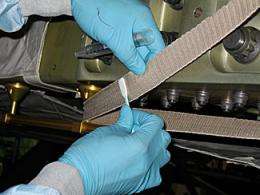
A technician swabs for microbes on a mockup of the interior of the International Space Station at NASA's Kennedy Space Center in Florida. This was done as part of a program to develop microbial sampling procedures for spaceflight. Credit: Erin Mulholland and Lane Dellwo, NASA

Humans spend greater than 90 percent of their time indoors, but we're never alone there. Bacteria and viruses, scientists estimate, make up half of the world's biomass—some 10 nonillion (1 followed by 31 zeros) microorganisms—and we most often meet them within enclosed spaces. So, that's where the modern microbe hunter often looks first. A new report issued by the National Institute of Standards and Technology (NIST) offers guidance to make the hunting more effective.

A fundamental understanding of the microbial community in the built environment—including estimates of diversity, function and concentration—is necessary to accurately assess human exposure, and in turn, the potential impacts on human health. To address the many challenges associated with characterizing this invisible biosphere, develop innovative approaches to make both aerosol and surface sampling more effective, and prioritize research efforts to optimize and standardize those methods, NIST, Yale University and the Alfred P. Sloan Foundation held the "Challenges in Microbial Sampling in the Indoor Environment Workshop" on Feb. 14-15, 2011, at NIST headquarters in Gaithersburg, Md. The new report summarizes the results of that workshop.

Traditionally, taking a "census" of the microflora in an indoor environment has been done by taking samples from both the air and various surfaces, growing them in nutrient media, identifying the different species that arose, and then extrapolating an estimated total quantity for each species based on the numbers present in the culture. This approach provides a view of the microbial population that is limited, unreliable and biased toward those few species that grow successfully in culture.

In recent years, culture-based detection, identification and quantification is being replaced by culture-independent characterization of an entire microbial community by studying the different genomic DNA sequences present. Attendees at the indoor sampling workshop were charged with optimizing this modern genomic approach to microbial analysis by:

• Detailing the current sample collection and processing procedures available to characterize the indoor microbiome;
• Determining the future requirements for monitoring and characterizing microbe communities;
• Defining the challenges and limitations with current methods;
• Prioritizing issues that should be addressed to meet future requirements; and
• Mapping the pathways and approaches that should be taken to develop and improve techniques to meet those needs.

The workshop summary report documents the results of these discussions, highlighting the current state of science, challenges and future priorities for surface and aerosol microbial analysis; exploring cross-cutting issues such as surface/aerosol microbiome relationships, education, training and public awareness; and providing a comprehensive overview of existing resources, including those for building and architectural considerations, sampling strategies, and worker safety and health guidelines.

Explore further: Captive-bred wallabies may carry antibiotic resistant bacteria into wild populations

More information: NIST Technical Note (TN) 1737, Challenges in Microbial Sampling in the Indoor Environment—Workshop Summary Report, is available online at www.nist.gov/mml/biochemical/biomolecular/upload/Sloan-Roport-Final-TN-1737.pdf.

add to favorites email to friend print save as pdf

Related Stories

Greenhouse gases: The measurement challenge

Aug 17, 2011

The continuing increase in the level of carbon dioxide and other "greenhouse gases" in the Earth's atmosphere has been identified as a cause for serious concern because it may radically accelerate changes in the Earth's climate. ...

House-sharing with microbes

Sep 09, 2010

Household dust contains up to 1000 different species of microbes, with tens of millions of individual bacterial cells in each gram. And these are just the ones that can be grown in the lab!

We're surrounded! House dust is a rich source of bacteria

Apr 08, 2008

If you’ve always suspected there are unknown things living in the dark and dusty corners of your home and office, we are now one step closer to cataloguing exactly what might be lurking in your indoor environment. Buildings ...

Large-scale sequencing: The future of genomic sciences?

Dec 17, 2009

Scientists can gain insights into new ways to use microorganisms in medicine and manufacturing through a coordinated large-scale effort to sequence the genomes of not just individual microorganisms but entire ecosystems, ...

Recommended for you

Scientists discover how rapamycin slows cell growth

49 minutes ago

University of Montreal researchers have discovered a novel molecular mechanism that can potentially slow the progression of some cancers and other diseases of abnormal growth. In the May 23 edition of the prestigious journal ...

Unlocking secrets of cell reproduction

9 hours ago

Research published in Open Biology today identifies, for the first time, nearly all the genes required for reproduction of a cell in a living organism.

What the smallest infectious agents reveal about evolution

21 hours ago

Radically different viruses share genes and are likely to share ancestry, according to research published in BioMed Central's open access journal Virology Journal this week. The comprehensive phylogenomic analysis compar ...

User comments : 0

More news stories

Scientists discover how rapamycin slows cell growth

University of Montreal researchers have discovered a novel molecular mechanism that can potentially slow the progression of some cancers and other diseases of abnormal growth. In the May 23 edition of the prestigious journal ...

White tiger mystery solved

White tigers today are only seen in zoos, but they belong in nature, say researchers reporting new evidence about what makes those tigers white. Their spectacular white coats are produced by a single change ...

NASA head views progress on asteroid lasso mission

Surrounded by engineers, NASA chief Charles Bolden inspected a prototype spacecraft engine that could power an audacious mission to lasso an asteroid and tow it closer to Earth for astronauts to explore.

Solar Kettle allows for boiling water off the grid

(Phys.org) —A company called Contemporary Energy has unveiled a new device it calls the Solar Kettle. It looks very much like a normal coffee thermos, but has flaps on one side that open to allow for collecting ...

Ferrets, pigs susceptible to H7N9 avian influenza virus

Chinese and U.S. scientists have used virus isolated from a person who died from H7N9 avian influenza infection to determine whether the virus could infect and be transmitted between ferrets. Ferrets are often used as a mammalian ...