Scientists make nontoxic, bendable nanosheets
Apr 11, 2012 By Anne Ju
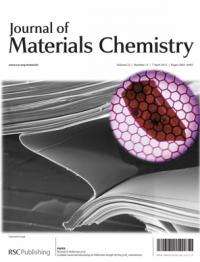
A scanning electron microscope image of the side of a stack of nanosheets. The inset is an optical microscope image of a single exfoliated nanosheet, to show it is optically transparent. Image: Robinson group

(Phys.org) -- Cornell materials scientists have developed an inexpensive, environmentally friendly way of synthesizing oxide crystal sheets, just nanometers thick, which have useful properties for electronics and alternative energy applications.

The work, led by Richard Robinson, assistant professor of materials science and engineering, is featured on the cover of the April 7 (Vol. 22, No. 13).

The millimeter-length, 20 nanometer-thick sodium-cobalt oxide crystals were derived through a novel method that combined a traditional sol-gel synthesis with an electric field-induced kinetic de-mixing step. It was this second step that led to the breakthrough of a bottom-up synthesis method through which tens of thousands of nanosheets self-assemble into a pellet.

The material has fascinating properties, Robinson said, including high thermoelectric power, high electrical conductivity, superconductivity and potential as a in batteries.

Usually oxide materials, like a ceramic coffee mug, aren't electrically conductive; they're insulating, Robinson said. Since the material is a conductive oxide, it can be used in thermoelectric devices to convert waste heat into power. Now that the researchers have made nanosheets, they expect the material's thermoelectric efficiency to improve, enabling the creation of more efficient alternative energy thermoelectric devices.

The nanosheets also show the ability to bend, sometimes up to 180 degrees, Robinson added. This is unusual for ceramics, which are normally brittle.

The material is based on common, abundant elements (sodium, cobalt and oxygen), without toxic elements, such as tellurium, that are normally used in .

The paper's co-authors are graduate students Mahmut Aksit and David Toledo. The work was supported by the National Science Foundation and the U.S. Department of Energy, through the Energy Materials Center at Cornell (EMC2).

Explore further: Researchers develop method to inkjet print highly conductive, bendable layers of graphene

Related Stories

Atom-thick sheets unlock future technologies

Feb 03, 2011

(PhysOrg.com) -- A new way of splitting layered materials, similar to graphite, into sheets of material just one atom thick could lead to revolutionary new electronic and energy storage technologies.

Recommended for you

Kinks and curves at the nanoscale

May 19, 2013

One of the basic principles of nanotechnology is that when you make things extremely small—one nanometer is about five atoms wide, 100,000 times smaller than the diameter of a human hair—they are going ...

Snake's ultra-black spots may aid high-tech quest

May 16, 2013

Scientists have identified nanostructures in the ultra-black skin markings of an African viper which they said Thursday could inspire the quest to create the ultimate light-absorbing material.

User comments : 0

More news stories

How gold nanoparticles can help fight ovarian cancer

Positively charged gold nanoparticles are usually toxic to cells, but cancer cells somehow manage to avoid nanoparticle toxicity. Mayo Clinic researchers found out why, and determined how to make the nanoparticles effective ...

Radioactive nanoparticles target cancer cells

Cancers of all types become most deadly when they metastasize and spread tumors throughout the body. Once cancer has reached this stage, it becomes very difficult for doctors to locate and treat the numerous tumors that can ...

Study says empathy plays a key role in moral judgments

Is it permissible to harm one to save many? Those who tend to say "yes" when faced with this classic dilemma are likely to be deficient in a specific kind of empathy, according to a report published in the scientific journal ...

If you can remember it, you can remember it wrong

(Medical Xpress)—Native peoples in regions where cameras are uncommon sometimes react with caution when their picture is taken. The fear that something must have been stolen from them to create the photo ...