The psychology of the left-turn lane: How human behavior influences traffic patterns
Apr 20, 2012
The psychology of the left-turn lane: How human behavior influences traffic patterns
DynusT is a simulation-based dynamic traffic assignment software program that supports engineers and planners in addressing transportation planning and operation issues. Credit: UA College of Engineering

University of Arizona traffic engineer Yi-Chang Chiu has embarked on a three-year traffic modeling research project to replace the 1950s model still used to forecast current transportation needs.

Chiu's new model incorporates individual human behavior traits into traffic modeling on a day-by-day basis, which will allow him and his team to forecast the evolution of behavior with a transportation system over a long period.

The project is known as VASTO, which comes from its full title, Evolutionary Agent System for Transportation Outlook.

"The deficiency in past practices basically lies in the inability to describe human behavior in a realistic manner," said Chiu, who also is director of the DynusT Lab at the UA College of Engineering. "In our past predictions, we treated everybody pretty much the same."

Previous models predicted population movement more on a macro level, Chiu said. "We simulate individuals."

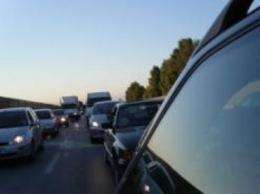
The human behavior element will be derived from census data and metropolitan planning organization travel surveys. This will incorporate the range of human whims with driving decisions, such as stopping at the store or suddenly deciding to go straight if too many cars are in the left-turn lane. VASTO simulates habitual patterns with real-time reactions.

This proposed VASTO marks the first time that individual is at the heart of traffic modeling rather than relying on past traffic trends and extrapolating them.

Chiu's ambition for VASTO is to give transportation planners a robust behavior based tool to find alternative ways to provide adequate transportation without necessarily just adding more lanes or building more roads.

"Most cities keep on building to meet peak congestion hours," Chiu said. He wants to determine whether we achieve more by building less, or by not building at all. "In the past we did not understand the mechanics of behavior so we didn't know how to manage data," he said.

The overall goal of the project is to completely change the approach to traffic management. Chiu wants to know: "If I don't build it, is there another way to manage and influence behavior? That way we can better utilize existing infrastructure."

This planning tool will allow planners to see what would happen if, for example, traffic was rerouted because of bridge construction, or if construction of a cross-town freeway was proposed, or a regional shopping center.

"You can perform what-if analyses," Chiu said. "We have not been able to do this in the past because the computer has not been fast enough to run a model in a reasonable amount of time."

The size of the $1.2 million FHWA grant is an indicator of the significance of Chiu's VASTO research. "In transportation, this is a top-of-the-line grant size," he said. "For a single project, that's very large."

VASTO will ultimately be a free, open-source technology, although users will require extensive training.

Explore further: Pakistan adopts Chinese rival GPS satellite system

add to favorites email to friend print save as pdf

Related Stories

Simulations means 'smarter traffic decisions'

Jun 10, 2008

Kyoto University and IBM's Tokyo Research Laboratory have developed a system that can simulate urban transport situations encompassing millions of individual vehicles in complex traffic interactions. A simulation can predict, ...

New study examines traffic congestion on a university campus

Mar 25, 2008

Some researchers believe that the United States is in a “congestion crisis”. Indeed, national transportation statistics indicate that 42 percent more vehicles used each urban lane mile in 2000 than in 1980, tripling the ...

Cell phone signals help manage traffic

Sep 26, 2011

In a pilot project in Texas, Siemens is developing intelligent transportation technology for the fast and orderly evacuation of citizens. In this project, traffic light timing systems register traffic flow ...

Defectors take the car, cooperators go by bus

Feb 03, 2009

National economies are driven by the automobile, even during an economic downturn. Every day, hundreds of millions of people take their cars to visit remote places, to commute, and to reach the supermarket.

Recommended for you

AP probe further strains Obama, press rapport

8 hours ago

Reports emerged last week that the Department of Justice had secretly obtained two months' worth of phone records of journalists at The Associated Press as part of a larger investigation into a failed al-Qaida ...

Pakistan adopts Chinese rival GPS satellite system

May 18, 2013

Pakistan is set to become the fifth Asian country to use China's domestic satellite navigation system which was launched as a rival to the US global positioning system, a report said Saturday.

British children's on-screen reading overtakes books

May 16, 2013

For the first time, British children are reading more on computers and other electronic devices than they are reading books, magazines, newspapers and comics, according to a study of nearly 35,000 youngsters ...

Exploring the artsy side of 3-D printing

May 16, 2013

Three-D printing technology is a game changer in the arts and crafts world. "It really takes the lid off of what's possible," says Andrej Suskavcevic, president and CEO of the Craft and Hobby Association, ...

User comments : 0

More news stories

UC Davis startup changes listening experience

Fifteen years of research at the University of California, Davis, is being turned into commercial products by Dysonics, a startup company based in San Francisco. Since becoming the first "graduate" from the Engineering Translational ...

Study shows how bilinguals switch between languages

(Medical Xpress)—Individuals who learn two languages at an early age seem to switch back and forth between separate "sound systems" for each language, according to new research conducted at the University of Arizona.

Non-wetting fabric drains sweat

(Phys.org) —Waterproof fabrics that whisk away sweat could be the latest application of microfluidic technology developed by bioengineers at the University of California, Davis.