NASA sees slow-developing System 99P dogging Northern Australia
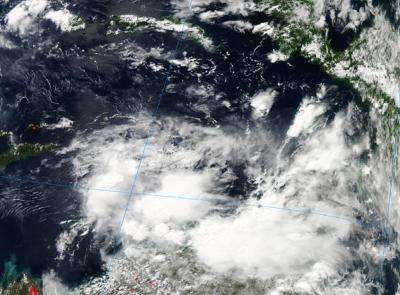
NASA satellites have been monitoring the slow-to-develop low pressure area called System 99P for four days as it lingers in the Arafura Sea, north Australia's Northern Territory. Satellite data indicates that System 99P is likely to continue struggling because of weak organization and nearby dry air.
System 99P was captured in an infrared image on April 20, 2012 at 04:55 UTC (12:55 a.m. EDT) by the Moderate Resolution Imaging Spectroradiometer (MODIS) instrument that flies onboard NASA's Aqua satellite. At that time, System 99P was centered about 190 nautical miles (218.6 miles/ 352 km) north-northeast of Darwin, Australia, near 9.9 South latitude and 132.6 East longitude. The western-most extent of System 99P was now entering the Timor Sea (located west of the Arafura Sea). In fact, today's (April 20) MODIS infrared imagery revealed that System 99P showed some areas of strong thunderstorms west of its center of circulation, over the eastern edge of the Timor Sea. However, those thunderstorms remain disorganized and the low-level circulation is weak.
The TRMM satellite, managed by NASA and JAXA also gathered data from struggling System 99P. The Tropical Rainfall Measuring Mission (TRMM) satellite passed over April 19 at 1142 UTC (7:42 a.m. EDT), and revealed curved banding of thunderstorms wrapping weakly into the center of the low. Total precipitable water products currently indicate there is sufficient moisture associated with the low, and that's the fuel for the tropical cyclone.
Even though there's a good amount of moisture available, dry air lingers nearby. Dry air can sap the life's blood (moisture) from a developing tropical cyclone. Satellite data shows dry air west of 130 East. In addition, an upper-air sounding from Darwin, Australia indicated dry air in its recent moisture profile.
The Joint Typhoon Warning Center (JTWC) is the entity that forecasts tropical cyclones in this part of the world and has been continuously gathering and analyzing data to determine if System 99P will further develop. JTWC cited surface observations from McCluer Island, which is located 65 nautical miles (74.8 miles/120.4 km) south-southeast of 99P's center. The island's weather observation noted northeasterly winds at 15-20 knots (17.3 - 23.0 mph / 27.7-37.0 kph). and sea level pressure near 1006 millibars.
Looking back, on April 19, System 99P was centered near 9.0S 132.8E, about 240 miles NE of Darwin, Australia and visible MODIS imagery from NASA's Terra satellite showed deep convection/t-storms flaring on western quadrant. At that time, maximum sustained winds were near 15 knots (17.3 mph/27.7 kph). On April 18 the MODIS image on NASA's Aqua satellite showed disorganized cloud cover as System 99P was still struggling. Its maximum sustained winds were 15 knots (17.3 mph/27.7 kph). When NASA passed over System 99P on the date of its birth, April 17, 2012, it was having a difficult time getting organized because of wind shear. It was located in the Arafura Sea, between northern Australia and Irian Jaya, Indonesia.
As of April 20, the forecasters at the JTWC said, "There is no significant model development due [in the next 24 hours] to the overall marginal environment and weak organization."
Provided by NASA's Goddard Space Flight Center


