Mini-sensor measures magnetic activity in human brain
Apr 19, 2012
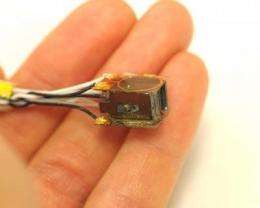
NIST's atom-based magnetic sensor, about the size of a sugar cube, can measure human brain activity. Inside the sensor head is a container of 100 billion rubidium atoms (not seen), packaged with micro-optics (a prism and a lens are visible in the center cutout). The light from a low-power infrared laser interacts with the atoms and is transmitted through the grey fiber-optic cable to register the magnetic field strength. The black and white wires are electrical connections. Credit: Knappe/NIST

A miniature atom-based magnetic sensor developed by the National Institute of Standards and Technology (NIST) has passed an important research milestone by successfully measuring human brain activity. Experiments reported this week verify the sensor's potential for biomedical applications such as studying mental processes and advancing the understanding of neurological diseases.

NIST and German scientists used the NIST sensor to measure alpha waves in the brain associated with a person opening and closing their eyes as well as signals resulting from stimulation of the hand. The measurements were verified by comparing them with signals recorded by a SQUID (superconducting device). SQUIDs are the world's most sensitive commercially available magnetometers and are considered the "gold standard" for such experiments. The NIST mini-sensor is slightly less sensitive now but has the potential for comparable performance while offering potential advantages in size, portability and cost.

The study results indicate the NIST mini-sensor may be useful in (MEG), a noninvasive procedure that measures the magnetic fields produced by electrical activity in the brain. MEG is used for basic research on perceptual and cognitive processes in healthy subjects as well as screening of visual perception in newborns and mapping brain activity prior to surgery to remove tumors or treat epilepsy. MEG also might be useful in brain-computer interfaces.

MEG currently relies on SQUID arrays mounted in heavy helmet-shaped flasks containing cryogenic coolants because SQUIDs work best at 4 degrees above absolute zero, or minus 269 degrees Celsius. The chip-scale NIST sensor is about the size of a sugar cube and operates at room temperature, so it might enable lightweight and flexible MEG helmets. It also would be less expensive to mass produce than typical atomic magnetometers, which are larger and more difficult to fabricate and assemble.

"We're focusing on making the sensors small, getting them close to the signal source, and making them manufacturable and ultimately low in cost," says NIST co-author Svenja Knappe. "By making an inexpensive system you could have one in every hospital to test for traumatic brain injuries and one for every football team."

The mini-sensor consists of a container of about 100 billion rubidium atoms in a gas, a low-power infrared laser and fiber optics for detecting the light signals that register magnetic field strength—the atoms absorb more light as the magnetic field increases. The sensor has been improved since it was used to measure human heart activity in 2010.** NIST scientists redesigned the heaters that vaporize the atoms and switched to a different type of optical fiber to enhance signal clarity.

The brain experiments were carried out in a magnetically shielded facility at the Physikalisch Technische Bundesanstalt (PTB) in Berlin, Germany, which has an ongoing program in biomagnetic imaging using human subjects. The NIST sensor measured magnetic signals of about 1 picotesla (trillionths of a tesla). For comparison, the Earth's magnetic field is 50 million times stronger (at 50 millionths of a tesla). NIST scientists expect to boost the mini-sensor's performance about tenfold by increasing the amount of light detected. Calculations suggest an enhanced sensor could match the sensitivity of SQUIDS. NIST scientists are also working on a preliminary multi-sensor magnetic imaging system in a prelude to testing clinically relevant applications.

Explore further: Perfectly designed microelectronics

More information: Biomedical Optics Express. Vol. 3, Issue 5, pp. 981

Provided by National Institute of Standards and Technology (NIST)

4.8 /5 (10 votes)

Related Stories

'NMR on a chip' features magnetic mini-sensor

Feb 19, 2008

A super-sensitive mini-sensor developed at the National Institute of Standards and Technology can detect nuclear magnetic resonance (NMR) in tiny samples of fluids flowing through a novel microchip. The prototype ...

Novel Zigzag Shape Gives Sensors Magnetic Appeal

Jan 05, 2005

Scientists at the National Institute of Standards and Technology (NIST) have designed tiny magnetic sensors in a "zigzag" shape that are simpler in design and likely will be cheaper to make than conventional ...

Tiny spectrometer offers precision laser calibration

May 11, 2007

A tiny device for calibrating or stabilizing precision lasers has been designed and demonstrated at the National Institute of Standards and Technology. The prototype device could replace table-top-sized instruments ...

Recommended for you

Pakistan adopts Chinese rival GPS satellite system

11 hours ago

Pakistan is set to become the fifth Asian country to use China's domestic satellite navigation system which was launched as a rival to the US global positioning system, a report said Saturday.

Morocco to harness the wind in energy hunt

12 hours ago

Morocco is ploughing ahead with a programme to boost wind energy production, particularly in the southern Tarfaya region, where Africa's largest wind farm is set to open in 2014.

Bernanke forecasts gains from computer technology

12 hours ago

(AP)—Federal Reserve Chairman Ben Bernanke says pessimists who are forecasting that the economy will not reap sizable benefits from the computer revolution are likely to be proven wrong.

Yahoo Japan suspects 22 million IDs stolen

15 hours ago

Yahoo Japan Corp. has said it suspects up to 22 million user IDs may have been stolen during an unauthorised attempt to access the administrative system of its Yahoo! Japan portal.

User comments : 3

Adjust slider to filter visible comments by rank

Display comments: newest first

tscati
not rated yet Apr 20, 2012
"atom-based"??? - as opposed to what? solid electrons?
slack
not rated yet Apr 20, 2012
"atom-based"??? - as opposed to what? solid electrons?


:-))
You've gotta wonder who writes up these articles sometimes...
randomwalk_
not rated yet Apr 20, 2012
"atom-based"??? - as opposed to what? solid electrons?


"chip-scale atomic magnetometer (CSAM) based on optical spectroscopy of alkali atoms"

http://www.optics...-3-5-981

More news stories

US seizes Bitcoin operator accounts

US authorities seized the accounts of a Bitcoin digital currency exchange operator, claiming it was functioning as an "unlicensed money service business," court documents showed Friday.

Morocco to harness the wind in energy hunt

Morocco is ploughing ahead with a programme to boost wind energy production, particularly in the southern Tarfaya region, where Africa's largest wind farm is set to open in 2014.

Galaxy's Ring of Fire

Johnny Cash may have preferred this galaxy's burning ring of fire to the one he sang about falling into in his popular song. The "starburst ring" seen at center in red and yellow hues is not the product of ...

Alaska volcano shoots ash 15,000 feet into the air

(AP)—One of Alaska's most restless volcanoes has shot an ash cloud 15,000 feet into the air in an ongoing eruption that has drawn attention from a nearby community but isn't expected to threaten air traffic.