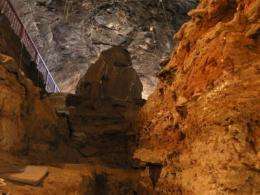
Human ancestors used fire one million years ago, archaeologist find
Apr 02, 2012
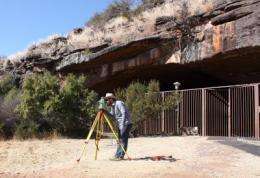
This is the surveying area outside Wonderwerk Cave, South Africa. Credit: L. Milosavljevic

An international team led by the University of Toronto and Hebrew University has identified the earliest known evidence of the use of fire by human ancestors. Microscopic traces of wood ash, alongside animal bones and stone tools, were found in a layer dated to one million years ago at the Wonderwerk Cave in South Africa.

"The analysis pushes the timing for the human use of fire back by 300,000 years, suggesting that as early as may have begun using fire as part of their way of life," said U of T anthropologist Michael Chazan, co-director of the project and director of U of T's Archaeology Centre.

The research will be published in the on April 2.

This is the view from the bottom of the excavated area towards the entrance to Wonderwerk Cave. Credit: R. Yates

Wonderwerk is a massive cave located near the edge of the Kalahari where earlier excavations by Peter Beaumont of the McGregor Museum in Kimberley, South Africa, had uncovered an extensive record of human occupation. A research project, co-directed by U of T's Chazan and Liora Kolska Horwitz of Hebrew University, has been doing detailed analysis of the material from Beaumont's excavation along with renewed field work on the Wonderwerk site. Analysis of sediment by lead authors Francesco Berna and Paul Goldberg of Boston University revealed ashed plant remains and burned , both which appear to have been burned locally rather than carried into the cave by wind or water. The researchers also found extensive evidence of surface discoloration that is typical of burning.
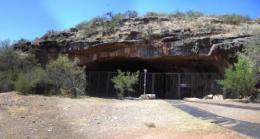
This is a panoramic view of the entrance to Wonderwerk Cave, South Africa. Credit: H. Ruther

"The control of fire would have been a major turning point in human evolution," says Chazan. "The impact of cooking food is well documented, but the impact of control over fire would have touched all elements of human society. Socializing around a camp fire might actually be an essential aspect of what makes us human."

Explore further: Actor Johnny Depp immortalized in ancient fossil find

More information: “Microstratigraphic evidence of in situ fire in the Acheulean strata of Wonderwerk Cave, Northern Cape Province, South Africa,” by Francesco Berna et al. PNAS (2012).

Related Stories

Earliest evidence of our cave-dwelling human ancestors

Dec 19, 2008

A research team led by Professor Michael Chazan, director of the University of Toronto's Archaeology Centre, has discovered the earliest evidence of our cave-dwelling human ancestors at the Wonderwerk Cave in South Africa.

World's oldest human remains claimed in Israel

Dec 28, 2010

Israeli archaeologists have discovered human remains dating from 400,000 years ago, challenging conventional wisdom that Homo sapiens originated in Africa, the leader of excavations in Israel said on Tuesday.

Recommended for you

The eloquence of the otoliths

May 16, 2013

Fish fossils that are about 23 million years old give unprecedented insight into the evolutionary history of the gobioid order, one of the most species-rich groups among the modern bony fishes.

Light cast on lifestyle and diet of first New Zealanders

May 16, 2013

(Phys.org) —A University of Otago-led multidisciplinary team of scientists have shed new light on the diet, lifestyles and movements of the first New Zealanders by analysing isotopes from their bones and teeth.

mtDNA study shows Minoans came from Europe not Africa

May 15, 2013

(Phys.org) —A new study conducted by a team of American and Greek researchers has found that the people of the ancient Minoan civilization living on the island of Crete most likely came from Europe. In ...

User comments : 2

Adjust slider to filter visible comments by rank

Display comments: newest first

baudrunner
5 / 5 (1) Apr 03, 2012
Looks like a pretty nice place. I'd live there.
MarkyMark
not rated yet Apr 21, 2012
I would suspect things looked different one million years ago.

But i share your generall oppinion.

More news stories

Evolution of lying

(Phys.org) —Ultimately, our ability to convincingly lie to each other may have evolved as a direct result of our cooperative nature.

Honeybees trained in Croatia to find land mines

(AP)—Mirjana Filipovic is still haunted by the land mine blast that killed her boyfriend and blew off her left leg while on a fishing trip nearly a decade ago. It happened in a field that was supposedly ...

Mice, gerbils perish in Russia space flight

A number of mice and eight gerbils sent into space in a Russian capsule destined to find out how well organisms can withstand extended flights perished during their journey, scientists said Sunday as the ...

Bold action, big money needed to curb Asia floods

Asia's flood-prone megacities should fund major drainage, water recycling and waste reduction projects to stem deluges and secure clean supply for their booming populations, experts said Sunday.