Glove designers plan messaging path for deaf-blind
Apr 07, 2012 by Nancy Owano report
Glove designers plan messaging path for deaf-blind

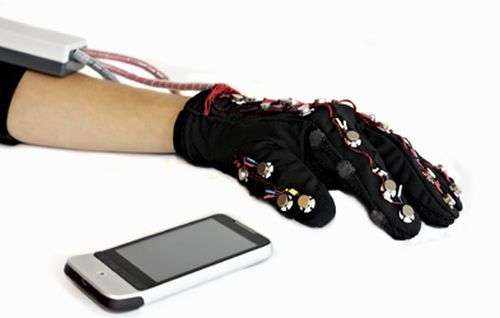
(Phys.org) -- People coping with the double absence of vision and hearing can communicate via mobile devices with the help of a special glove, now under development in Germany’s Design Research Lab. The Mobile Lorm Glove is a wearable device that lets the user compose messages to be transmitted to the receiver’s smartphone. This same glove allows the deaf-blind user to receive incoming messages as well. Basically, the person who cannot see or hear can use tactile feedback to send and receive communications.

The lab developers tell the story of what kind of difference their glove can make: People who are deaf-blind may depend on a touch sign language alphabet called Lorm that assigns characters to different areas of the hand. Such dependence seriously limits the number of people with whom they can communicate—with others who know Lorm and are within physical contact.

This video is not supported by your browser at this time.

The alphabet gets its name from the creator, a philosopher and poet who lost his hearing at 15 and found that he was losing his sight. To cope,. he came up with a hand touch alphabet for the deaf-blind, and the alphabet eventually became known in some European countries as Lorm's alphabet. Mikulov Heinrich Landesman was the creator’s real name but he had to use the pseudonym Hieronymus Lorm to escape persecution, according to accounts.

What the glove does is resolve the alphabet limits; it translates the Lorm alphabet into digital text and vice versa, using pressure points. Incoming messages are received by small vibrators on the back of the glove, which translate messages into vibrations. Outgoing messages are also served by the glove‘s textile pressure sensors on the palm of the glove. They translate "Lorm" into text or speech via mobile phone. These pressure sensors correspond to the Lorm to construct the words and sentences.

A Bluetooth module manages the transmission between glove and phone The Bluetooth connection sends data from the glove to the user’s phone. It is forwarded to the receiver’s phone in the form of an SMS. When the glove wearer gets a text message, it is forwarded via Bluetooth from the phone to the glove.

The project was developed at the Design Research Lab by Tom Bieling, Ulrike Gollner and Gesche Joost. The Mobile Lorm Glove is in prototype, and the next phase of research will include direct speech input and output. Eventually, they see the glove as beneficial in broader ways than email and texting. The developers suggest the device will make reading e-books easier, as they put it, “to also ‘feel’ E-Books or Audiobooks."

Explore further: Inventor creates Card Beams with 3D printer

More information: www.design-research-lab.org/?projects=mobile-lorm-glove

Related Stories

Space Image: Man and machine

Mar 19, 2012

(PhysOrg.com) -- While Robonaut 2 has been busy testing its technology in microgravity aboard the International Space Station, NASA and General Motors have been working together on the ground to find new ways ...

Mouse glove is designed for new comfort zones

Feb 28, 2012

(PhysOrg.com) -- Yet another alternative to the conventional computer mouse is being marketed, this time a pull-on glove that behaves as a mouse. The Ion Wireless Air Mouse Glove is from a Cocoa, Florida-base ...

FDA approves new type of latex glove

Apr 23, 2008

The U.S. Food and Drug Administration Wednesday announced approval of the first glove made from a new form of natural rubber latex, guayule latex.

GM, NASA jointly developing robotic gloves for human use

Mar 14, 2012

(PhysOrg.com) -- General Motors and NASA are jointly developing a robotic glove that auto workers and astronauts can wear to help do their respective jobs better while potentially reducing the risk of repetitive ...

Recommended for you

Inventor creates Card Beams with 3D printer

May 23, 2013

What are card beams, you may ask? They are the building toy that allows you to build gravity-defying houses of cards with the help of friction, gravity, and two types of beams - the cap and the connector.

With high-tech guns, users could disable remotely

May 21, 2013

A high-tech startup is wading into the gun control debate with a cellphone controller that would allow gun owners to know when their weapon is being moved—and disable it remotely.

Game system castAR debuts at Maker Faire

May 21, 2013

(Phys.org) —Two tech talents, formerly employees at video game publisher Valve, have been working on their own vision in the form of game-ready glasses. Their company, Technical Illusions, will seek to ...

China police billions spell profit opportunity

May 19, 2013

Mannequins in riot gear, armoured cars and drones line a police equipment and "anti-terrorism technology" trade fair in Beijing as vendors seek to profit from China's huge internal security budget.

User comments : 0

More news stories

Yahoo, pay-TV operators among Hulu bidders

Online video site Hulu is again up for sale, with Yahoo and pay TV operators DirecTV and Time Warner Cable among the seven bidders, according to a person with direct knowledge of the matter.

Radiation leak at Japan lab; small impact expected

An atomic research lab in northern Japan has reported a radiation leak that may have affected about 50 people, though none were hospitalized and no impact was expected outside the facility, the lab's operator ...