Chimpanzee ground nests offer new insight into our ancestors descent from the trees
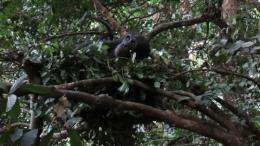
The first study into rarely documented ground-nest building by wild chimpanzees offers new clues about the ancient transition of early hominins from sleeping in trees to sleeping on the ground. While most apes build nests in trees, this study, published in the American Journal of Physical Anthropology, focused on a group of wild West African chimpanzees that often shows ground-nesting behaviour.
An international team of primatologists from the University of Cambridge and Kyoto University, led by Dr Kathelijne Koops, studied the chimpanzee (Pan troglodytes verus) population in the Nimba Mountains in Guinea, West Africa. All species of great ape build nests to sleep in each night. Construction of these shelters takes minutes as the apes bend, break and interweave branches into a circular frame, followed by tucking in smaller branches to form a sturdy but comfortable sleeping platform.
"We believe that, like modern apes, the common ancestor of chimpanzees and humans also slept in the trees 6 million years ago," said Dr Koops. "However, these nests are not preserved in the fossil or archaeological record, so it is impossible to study directly the ancient transition from sleeping in trees to building shelters on the ground. Recording this rare behaviour in the chimpanzee, our closest relative, may provide vital clues."
As the Nimba chimpanzees do not yet tolerate human presence at close range, the team used new molecular genetic techniques to analyse hairs collected from the nests. This allowed the team to establish the sex of chimpanzees displaying the behaviour and to identify individuals in the group.
The team showed that as chimpanzees sleep both on the ground and in the trees, the transition from trees to the ground did not require a special evolutionary adaptation. This suggests that early hominins may have slept on the ground before the emergence of Homo erectus ('upright man'), the first species which was fully adapted to living on the ground. "This is intriguing as it has long been believed that coming down from the trees was a crucial evolutionary shift," said Koops. "However, this chimpanzees' behaviour suggests a more deep-seated, gradual transition from tree-to-ground sleep."
Other theories for the tree-to-ground transition have included the use of fire and the scarcity of trees in open habitats. The team demonstrated that neither is a prerequisite for ground sleeping, as the chimpanzees live in a plentiful evergreen rainforest and do not create fire.
"These chimpanzees offer a rare opportunity to investigate why a population of wild apes chooses to sleep on the ground," concluded Koops. "We showed that ground-nesting was not caused by male mate-guarding behaviour, a lack of trees in which to nest, or because of fire. This suggests that our direct ancestors were neither the only, nor the first, species to come down from the trees."
More information: Koops. K, McGrew. W, Matsuzawa. T, Knapp. L, “Terrestrial Nest-Building by Wild Chimpanzees (Pan troglodytes): Implications for the Tree-to-Ground Sleep Transition in Early Hominins,” American Journal of Physical Anthropology, April 2012, DOI: 10.1002/ajpa.22056
Journal information: American Journal of Physical Anthropology
Provided by Wiley


