Children perceive humanoid robot as emotional, moral being
Apr 06, 2012 By Molly McElroy
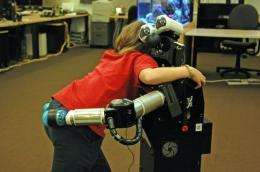
A study participant and Robovie share a hug, one of the social interactions in the UW experiment. Credit: American Psychological Association

(PhysOrg.com) -- Robot nannies could diminish child care worries for parents of young children. Equipped with alarms and monitoring capabilities to guard children from harm, a robot nanny would let parents leave youngsters at home without a babysitter.

Sign us up, parents might say.

Human-like robot babysitters are in the works, but it's unclear at this early stage what children's relationships with these humanoids will be like and what dangers lurk in this convenient-sounding technology.

Will the robots do more than keep children safe and entertained? Will they be capable of fostering social interactions, , intellectual growth and other cognitive aspects of human existence? Will children treat these as personified entities, or like servants or tools that can be bought and sold, misused or ignored?

"We need to talk about how to best design social robots for children, because will go with the design that makes the most money, not necessarily what’s best for children" said Peter Kahn, associate professor of psychology at the University of Washington. "In developing robot nannies, we should be concerned with how we might be dumbing down relationships and stunting the emotional and intellectual growth of children."

To guide robot design, Kahn and his research team are exploring how children interact socially with a humanoid robot. In a new study, the researchers report that children exchanged social pleasantries, such as shaking hands, hugging and making small talk, with a remotely controlled human-like robot (Robovie) that appeared autonomous. Nearly 80 percent of the children – an even mix of 90 boys and girls, aged 9, 12 or 15 – believed that the robot was intelligent, and 60 percent believed it had feelings.

The journal Developmental Psychology published the findings in its March issue.

The children also played a game of "I Spy" with Robovie, allowing the researchers to test what morality children attribute to the robot. The game started with the children guessing an object in the room chosen by Robovie, who then got a turn to guess an object chosen by the child.

But the humanoid robot’s turn was cut short when a researcher interrupted to say it was time for the interview part of the experiment and told Robovie that it had to go into a storage closet. Via a hidden experimenter's commands, Robovie protested, and said that it wasn't fair to end the game early. "I wasn't given enough chances to guess the object," the robot argued, going on to say that its feelings were hurt and that the closet was dark and scary.

When interviewed by the researchers, 88 percent of the children thought the robot was treated unfairly in not having a chance to take its turn, and 54 percent thought that it was not right to put it in the closet. A little more than half said that they would go to Robovie for emotional support or to share secrets.

But they were less agreeable about allowing Robovie civil liberties, like being paid for work. The children also said that the robot could be bought, sold and should not have the right to vote.

The findings show that the social interactions with Robovie led children to develop feelings for the robot and attribute some moral standing to it. This suggests that the interactions used in the study represent aspects of human experience that could be used for designing robots.

The researchers added that robot nanny design should also factor in how agreeable a robot should be with a child. Should a be programmed to give in to all the child's desires, play whatever game is demanded? Or should it push back, like Robovie did when the I Spy game ended early?

Kahn believes that as social robots become pervasive in our everyday lives, they can benefit but also potentially impoverish their emotional and social development.

The National Science Foundation funded the study. Co-authors at UW are Nathan Freier, Rachel Severson, Jolina Ruckert and Solace Shen. Other co-authors are Brian Gill of Seattle Pacific University, and Hiroshi Ishiguro and Takayuki Kanda, both of Advanced Telecommunications Research Institute, which created Robovie.

Explore further: Robots learn to take a proper handoff by following digitized human examples

More information: Learn more, watch videos at Kahn's lab website.

Related Stories

Robots to help children to form relationships

May 29, 2007

A project which is using robots to help children with developmental or cognitive impairments to interact more effectively has just started at the University of Hertfordshire.

Humanoids run world's first robot marathon race

Feb 26, 2011

Robovie-PC, a toy-sized humanoid, won the world's first full-length marathon for two-legged robots by a whisker Saturday, beating its closest rival by a single second after more than two days of racing. ...

Robotic dragon, an unlikely teacher

Oct 21, 2011

David DeSteno, an associate professor of psychology at Northeastern, and researchers from the Massachusetts Institute of Technology (MIT) and Harvard University, are examining how social robots can aid preschoolers ...

Robot marathon kicks off in Japan (Update)

Feb 24, 2011

The world's first full-length marathon for two-legged robots kicked off in Japan on Thursday, with the toy-sized humanoids were due to run 42.195 kilometres (26 miles) over four days.

Recommended for you

First Look: New Xbox elegant, but much unknown

May 22, 2013

Will gamers want One? After four years of development, Microsoft unveiled the Xbox One entertainment console and touted it as an all-in-one solution for playing games, watching TV and doing everything in ...

The new consoles from Microsoft, Nintendo and Sony

May 21, 2013

Microsoft is the last of the three big video game console makers to unveil its latest gaming system. Tuesday's unveiling comes nearly eight years after the Xbox 360 went on sale. It follows last fall's de ...

Microsoft readies new Xbox as entertainment hub

May 21, 2013

Microsoft offers a glimpse Tuesday at a new-generation Xbox as videogame consoles evolve into home entertainment centers and adapt to competition from smartphones and tablets.

Finnish start-up launches smartphone to rival giants

May 20, 2013

A group of ex-Nokia employees who quit over the company's decision to abandon the planned MeeGo operating system in favour of Windows presented their own smartphone on Monday, hoping to rival the sector's ...

User comments : 4

Adjust slider to filter visible comments by rank

Display comments: newest first

kaasinees
0.3 / 5 (22) Apr 06, 2012
that robot is groping that kids ass, pedo.
Vendicar_Decarian
0.1 / 5 (35) Apr 06, 2012
It is for that very reason that hugging between children is banned activity in some American Schools. Punishable by counseling, detention, and expulsion.

gurloc
5 / 5 (1) Apr 10, 2012
"Children perceive humanoid robot as emotional, moral being."

So robots are already more convincing then Mitt Romney?
BrettC
not rated yet Apr 23, 2012
It is for that very reason that hugging between children is banned activity in some American Schools. Punishable by counseling, detention, and expulsion.


It's quite sad that someday a Robot could teach a child Morality and Empathy better than a human.

More news stories

First Look: New Xbox elegant, but much unknown

Will gamers want One? After four years of development, Microsoft unveiled the Xbox One entertainment console and touted it as an all-in-one solution for playing games, watching TV and doing everything in ...

Expectations high for next Xbox

It's almost time for a new Xbox. Eight years have passed since Microsoft unveiled the Xbox 360, double the amount of time between the original Xbox debut in 2001 and its high-definition successor's launch ...

The new consoles from Microsoft, Nintendo and Sony

Microsoft is the last of the three big video game console makers to unveil its latest gaming system. Tuesday's unveiling comes nearly eight years after the Xbox 360 went on sale. It follows last fall's de ...

NEC phone is liquid-cooled and gender-specific

(Phys.org) —Pink is the color of princess fairy-tale gowns, magic slippers, upscale cupcake icing, and everything else favorable to girls who just want to be girls. "Ladyphones" appear to be concepts for ...

Chemists find new compounds to curb staph infection

(Phys.org) —In an age when microbial pathogens are growing increasingly resistant to the conventional antibiotics used to tamp down infection, a team of Wisconsin scientists has synthesized a potent new ...

Key find for early bladder cancer treatment

Aggressive forms of bladder cancer involve the protein PODXL – a discovery that could hold the key to improved treatment, according to researchers at Lund University, Uppsala University and KTH in Sweden.