Biologists predict extinction for organisms with poor quality genes
Apr 16, 2012
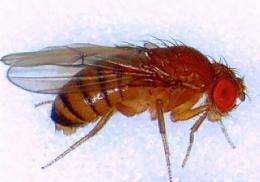
A genetic study by evolutionary biologists using fruit flies (Drosophila melanogaster) has shown that organisms with low-quality genes may produce offspring with even more inferior chromosomes, possibly leading to the extinction of certain species over generations. Credit: Nathaniel Sharp

Evolutionary biologists at the University of Toronto have found that individuals with low-quality genes may produce offspring with even more inferior chromosomes, possibly leading to the extinction of certain species over generations.

A study published in (PNAS) predicts that organisms with such genetic deficiencies could experience an increased number of in their DNA, relative to individuals with high-quality genes. The research was done on fruit flies whose simple system replicates aspects of biology in more , so the findings could have implications for humans.

"Mutations play a key role in cancer and other health problems affecting humans and other species," says Nathaniel Sharp, PhD candidate in U of T's Department of Ecology & Evolutionary Biology (EEB) and lead author of the study. "Our research suggests that the problem is likely to compound over time, leading to a mutational meltdown that may devastate endangered populations, and increase the risk of health problems in families in poor condition."

Sharp and EEB professor Aneil Agrawal examined the accumulation of mutations in the fruit fly Drosophila melanogaster, the genes of which are arranged on three major . To manipulate genetic quality, they introduced harmful mutations onto the fly's third chromosome. They then observed how the presence of these mutations affected the fitness of the second chromosome over 46 generations.

"Copies of chromosome two maintained in strains with poor-quality copies of chromosome three declined in fitness two to three times faster than those with good copies of chromosome three, suggesting that poor genetic quality elevates the mutation rate," says Sharp. While the underlying mechanism remains unknown, it could be tied to how an affected individual is less capable of repairing DNA or is more susceptible to DNA damage.

are especially useful for genetic studies such as this for the ability to screen for thousands of genes in thousands of flies much faster than in mammals. Flies are inexpensive to care for and reproduce rapidly, allowing for several generations to be studied in just a few months.

The researchers do, however, offer a more positive possible result of the process. "An elevated mutation rate under conditions of genetic or environmental stress could also accelerate adaptation to new environments," says Sharp.

Explore further: Evolution shapes new rules for ant behavior

More information: The findings are reported in the paper "Evidence for elevated mutation rates in low-quality genotypes".

Related Stories

Picky-eater Flies Losing Smell Genes

Apr 02, 2007

A UC Davis researcher is hot on the scent of some lost fruit fly genes. According to population biology graduate student Carolyn McBride, the specialist fruit fly Drosophila sechellia is losing genes for smell and taste receptors ...

Study: Junk DNA is critically important

Oct 19, 2005

A University of California-San Diego scientist says genetic material derisively called "junk" DNA is important to an organism's evolutionary survival.

Recommended for you

Honeybees trained in Croatia to find land mines

3 hours ago

(AP)—Mirjana Filipovic is still haunted by the land mine blast that killed her boyfriend and blew off her left leg while on a fishing trip nearly a decade ago. It happened in a field that was supposedly ...

Front-row seats to climate change

May 17, 2013

By day, insects provide the white noise of the South, but the night belongs to the amphibians. In a typical year, the Southern air hangs heavy from the humidity and the sounds of wildlife.

Climate change may have little impact on tropical lizards

May 17, 2013

A new Dartmouth College study finds human-caused climate change may have little impact on many species of tropical lizards, contradicting a host of recent studies that predict their widespread extinction in a rapidly warming ...

Wetlands: value to locals matters most

May 17, 2013

A new way of valuing ecosystem services, incorporating the local perspective, is the driving force behind a project assessing aquatic ecosystems in highland areas of Asia

User comments : 3

Adjust slider to filter visible comments by rank

Display comments: newest first

mosahlah
1 / 5 (1) Apr 16, 2012
I imagine benevolent and socialist western societies propagates poor genes at a higher rate than the most productive of our species. I should expect the same fate would apply to our culture. Mandarin lessons anyone?
Old Badger
2.3 / 5 (3) Apr 16, 2012
Now let me get this straight.....genetic mutation is the fundamental requirement for natural selection to take place....pity it leads to rapid extinction!!
klawy
1 / 5 (1) Apr 16, 2012
Isin't this NS a little bit reformulated or am I missing something? Good genes and you will probably survive, bad you will probably die - haven't we comprehended that yet?

More news stories

Honeybees trained in Croatia to find land mines

(AP)—Mirjana Filipovic is still haunted by the land mine blast that killed her boyfriend and blew off her left leg while on a fishing trip nearly a decade ago. It happened in a field that was supposedly ...

Russia retrieves mice, newts from space

A Russian capsule filled with 45 mice and 15 newts along with other small animals returned from a month's mission in orbit on Sunday with data scientists hope will pave the way for a manned flight to Mars.

German energy shift faces headwinds

Tense engineers have their eyes peeled on complex colour-coded diagrams on a wall-sized screen that makes their control room look like the inside of a spaceship.